

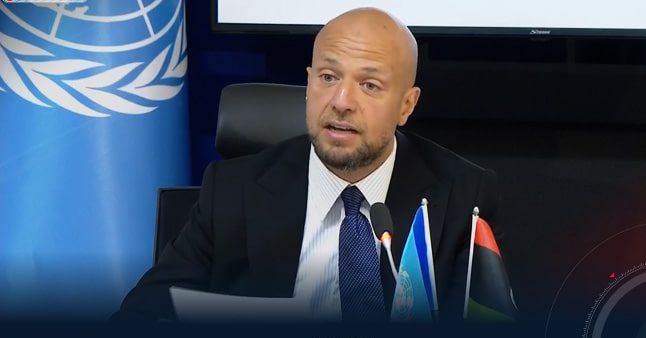
Tripoli – Walid Al-Lafi, head of the Government of National Unity’s delegation to the ‘4+4’ Committee, described the agreement signed in Tripoli as a milestone for Libyan-led progress. He said the deal represents a breakthrough after more than ten years of deadlock, providing a legal and organizational framework to address key obstacles to national elections.
During the signing ceremony, Al-Lafi stated that the committee achieved an essential part of its vision: viewing elections as the most effective way to unify Libya’s legislative, executive, and military institutions and renew their legitimacy through the will of the people.
Al-Lafi praised the direct bilateral negotiations between the conflict’s main parties, noting their success in reaching agreements such as forming a unified central bank board and a development spending plan, despite difficulties implementing the latter. He said these experiences show that mutual understanding is possible with the right dialogue approach.
While political rivalry continues and may persist, Al-Lafi said this is a normal part of political life and diversity. He emphasized that ongoing disputes have not prevented parties from finding common ground, which paves the way for institutions to draw legitimacy from the public. He expressed hope that the agreement would serve as a foundation for further national progress.
Al-Lafi explained that, although some voices consider the unification of executive and military institutions a necessary step for optimal election preparations, the agreement does not allow this criterion to become a new obstacle to the political process. He acknowledged that institution unification would be positive, but failure to achieve it should not block the path to elections. He stressed that, according to Article 4 of the agreement, direct access to elections remains open.
He urged everyone not to view the agreement as a win-lose situation, emphasizing that citizens and the country suffer most from the continued absence of institutions with electoral legitimacy. Al-Lafi warned that solutions would remain incomplete and crises unresolved unless legitimacy returns to its source: the will of the people and the ballot box.
Al-Lafi called on all relevant bodies and parties to support the agreement and avoid disrupting its progress. “The train stopped for many years. This is a good sign that it can move again. Do not hinder its journey—support it and clear the path ahead,” he said. He added that Libyans are tired of temporary measures, unfinished initiatives, and delaying tactics. He stressed that they deserve change, renewal, and the right to choose their leaders.
He cited Prime Minister Abdulhamid Dbeibeh’s previous statement: “Let us all leave—yes, all of us—but through elections, as soon as possible.”
Al-Lafi also thanked the United Nations Support Mission in Libya for facilitating dialogue without interference and for bringing the parties closer without dictating terms or replacing Libyans in making their decisions. He noted that the agreement includes ongoing commitments from the ‘4+4’ Committee and permanent mechanisms to oversee technical, logistical, and security requirements vital for successful elections and turning the agreement’s terms into actionable commitments.
Al-Lafi concluded by stressing that the true test of any agreement lies in how it is implemented, not just in the wording. “The real test begins after signing, not at the signing itself,” he said.