

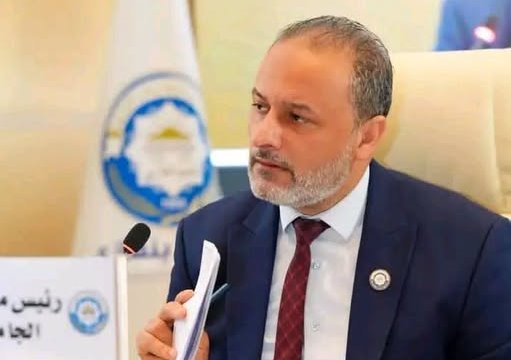
Benghazi – The Libyan government’s Cabinet has renewed its confidence in Professor Ezzeddin Younis Al-Darsi, extending his term as president of the University of Benghazi, known as the “Mother of Libyan Universities.” Al-Darsi has led the institution through exceptional circumstances, overseeing its reconstruction and significant academic and structural transformation after years of turmoil.
The decision to reappoint Al-Darsi follows a period during which the university transitioned from widespread destruction caused by years of conflict to becoming a modern academic institution. This recovery was part of a large-scale rebuilding and development project carried out by the Libyan Development and Reconstruction Fund under its director, Engineer Blqasem Khalifa Haftar, in coordination with the university leadership.
The reconstruction covered all colleges and educational, administrative, and service buildings. The university saw unprecedented upgrades in facilities and equipment, alongside efforts to maintain and develop academic activity and enhance the quality of education and scientific research.
Academically, Al-Darsi earned a postgraduate diploma from the University of Benghazi in 2001, graduating first in his class. He became director of quality assurance and performance evaluation at the university that same year. He completed a master’s degree in history in 2005, and received a doctorate from Mansoura University in Egypt in 2013, with honors, for his dissertation on “Trade Relations Between Genoa and the Maghreb at the End of the Middle Ages.”
Al-Darsi has held various academic and administrative roles at the University of Benghazi. He served as vice president for academic affairs in 2018 and worked on several committees and departments related to quality assurance, strategic planning, academic development, scientific journals, and organizational structures before being appointed university president in March 2019.
During his presidency, the university prioritized academic accreditation, international rankings, and partnerships with foreign academic institutions. Al-Darsi also led the university through the reconstruction process, restoring the main campus and advancing the educational environment.
His reappointment was welcomed among faculty, staff, and students within and outside the university. Many expressed appreciation for the decision, attributing it to the improved stability and development of the university’s facilities and academic environment under Al-Darsi’s leadership.
Looking ahead, university stakeholders hope to build on recent infrastructure improvements to raise the quality of education, student services, and research outcomes, reinforcing the institution’s local and international standing as the “Mother of Libyan Universities.”