

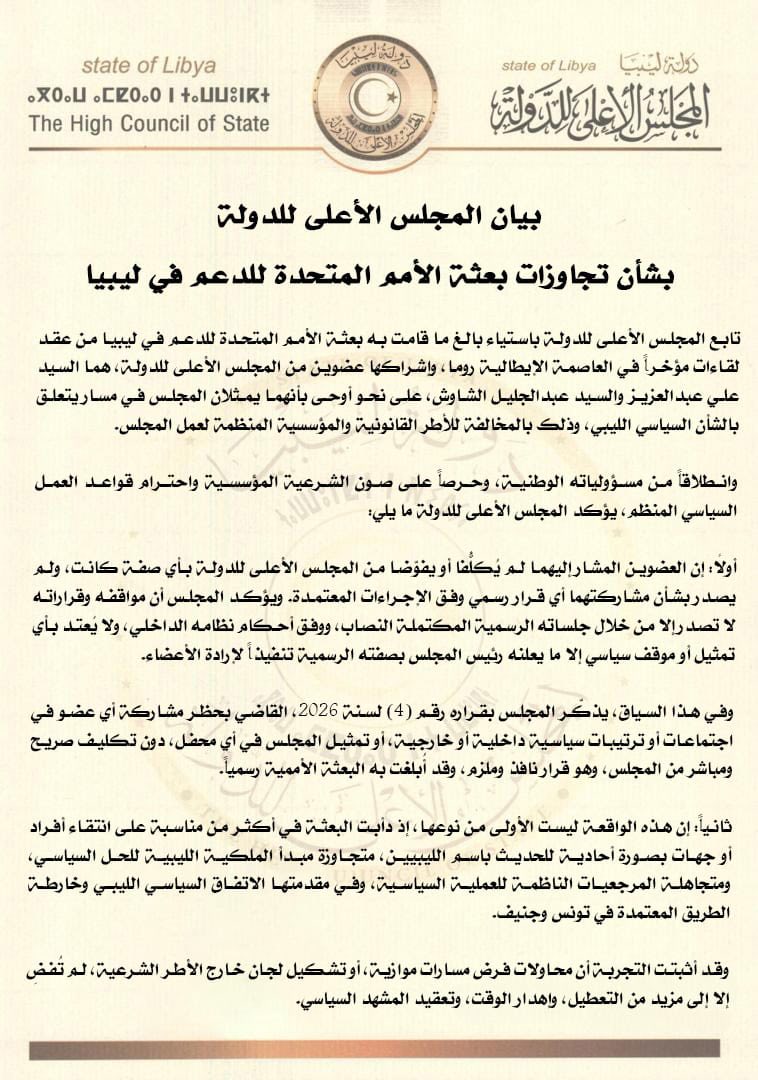
Tripoli – The High Council of State expressed its dissatisfaction. This concerned recent meetings held by the UN mission in Libya in Rome. The mission involved two Council members in a political track regarding Libyan affairs. This violated the Council’s legal and institutional frameworks.
The Council affirmed in a statement that “Ali Abdul Aziz” and “Abdul Jalil Al-Shaoush” were not authorized. They were not delegated in any capacity. No official decision approved their participation. This was contrary to adopted procedures. The Council emphasized that its positions and decisions originate only from its official sessions. These sessions must meet a quorum. No political representation or stance is valid unless declared by the Council’s Chairman. This must be in his official capacity.
The Council recalled its Resolution No. (4) of 2026. This resolution prohibits any member from participating in political meetings or arrangements. This applies to both internal and external events. It also bars representing the Council in any forum. This is without explicit and direct authorization from the Council. The resolution is enforceable and binding. The UN mission was officially informed of it.
The statement noted this incident is not unique. The mission has frequently selected individuals or entities unilaterally. These individuals spoke on behalf of Libyans. This bypassed the principle of Libyan ownership over the political solution. It ignored the regulatory frameworks of the political process. These include the Libyan Political Agreement. It also ignored the roadmap adopted in Tunis and Geneva.
The Council warned against attempts to impose parallel tracks. It also warned against forming committees outside legitimate frameworks. Such actions would only lead to further delays. They would waste time. They would complicate the political scene.
The Council stated that the United Nations mission, through these practices, deviates from its role. Its role is to provide support and assistance. Instead, it becomes a disruptive party. It complicates the political landscape. It fuels division. It undermines national consensus opportunities. The mission’s primary duty is to facilitate dialogue between legitimate institutions. It should respect the will of the Libyan people.
The statement expressed strong surprise. The mission ignored the consensus achieved between the committees of the High Council of State and the House of Representatives. This consensus concerned the High National Elections Commission dossier. The agreement occurred in the presence of the Deputy Head of the Mission. The mission also ignored the signing of this agreement by the heads of both councils. This behavior raises serious questions about the criteria for UN engagement. It concerns national understandings.
The Council affirmed the invalidity of any efforts or arrangements. These efforts assign the task of forming the High Elections Commission to unauthorized parties. They also concern preparing electoral laws. These actions contradict the Libyan Political Agreement. They contravene the Bouznika Agreement’s clear mechanisms. These mechanisms specify procedures for sovereign positions.
It clarified that any understandings, outcomes, or results from the Rome meetings are not binding. They do not commit the High Council of State or its institutions. They have no legal or political effect. They remain null and void.
The High Council of State called on all its members. They must strictly adhere to internal regulations. They should preserve unity. They must prioritize the supreme national interest. This must be done through approved official channels.
The statement also called on the United Nations Support Mission in Libya (UNSMIL) to review its approach. It should respect Libyan institutional sovereignty. It must adhere to the limits of its mandate. It needs to deal with legitimate institutions. This should align with valid legislation. It should also follow approved political agreements. This will enhance stability opportunities. It will serve the aspirations of the Libyan people.