

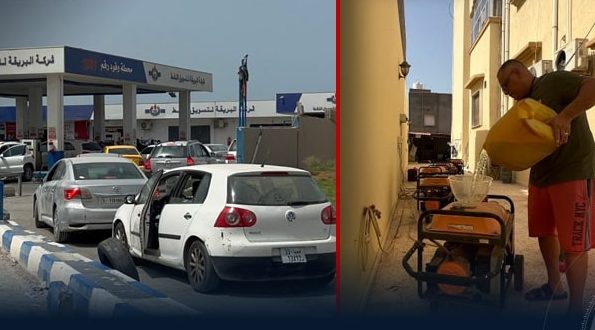
Tripoli – A field report by China’s Xinhua News Agency has highlighted the growing hardships faced by residents of Tripoli due to severe shortages of fuel, electricity, and water.
Ahmed Al-Sharif, a 49-year-old truck driver, told the agency he is considering selling his truck after seven years of ownership. The vehicle is his family’s only source of income, which he uses to move furniture and support his family of six. Al-Sharif and other drivers are struggling to find diesel as the fuel crisis worsens and power outages continue for a sixth consecutive week.
Al-Sharif spent hours waiting in a long line at a Tripoli gas station as temperatures approached 40 degrees Celsius. He explained that waiting for fuel can last two to three days. Power cuts can add even more hours if stations are forced to suspend operations. “If there’s a total blackout, we’re forced to wait for an unknown period,” he said. “Buying diesel on the black market costs more than my daily income.”
Al-Sharif said he may need to borrow money or look for other work to provide for his family. He pointed out that the start of the new school year and rising prices are increasing his financial burdens.
The crisis is not limited to truck drivers. Businesses in Tripoli have also been affected by power cuts. Khaled Ibrahim, a 32-year-old supermarket owner in eastern Tripoli, said power outages lasting more than ten hours have halted refrigeration equipment. As a result, he has lost chilled water and some frozen products have spoiled.
The water supply is also threatened by the crisis. Parts of the city have faced interruptions in supplies from the Great Man-Made River system, which has forced Rafaa Zaid, a café owner in central Tripoli, to close his business due to a lack of water. Zaid said it is possible to use a generator to overcome short power outages, but without water, it is impossible to operate the café, even though he continues to pay rent. “Every day I am closed is another loss, but what can I do? I can’t work without water,” he said.
Tarik Al-Tarhouni, an energy expert, told Xinhua that the root of the crisis goes beyond a simple shortage in power generation. He said the problem lies in the overall management of the sector. Al-Tarhouni called for a sustainable solution based on efficiency, reliability, diversity, and decentralization, including rehabilitating traditional power stations, strengthening the grid, and improving demand management.