

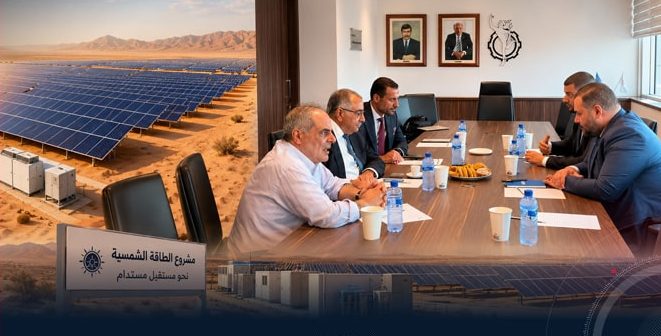
Libya – A delegation from the National Development Authority met with the Cyprus Chamber of Commerce and Industry to discuss ways to strengthen economic and trade relations between Libya and Cyprus. The talks focused on expanding cooperation in key sectors such as construction, infrastructure, and renewable energy. Both sides also explored opportunities for partnerships in the development and modernization of ports and airports, as well as the establishment of new business ventures.
According to the Cyprus Mail newspaper, the Libyan delegation held a series of bilateral meetings organized by the Cyprus Chamber with representatives from several Cypriot companies. These meetings covered potential projects, investment opportunities, and areas of shared interest. The Chamber emphasized that broad interest and participation from Cypriot businesses reflect genuine potential to deepen economic ties with Libya. It also expressed the Cypriot business community’s readiness to share its expertise and support Libya’s development efforts. The Chamber reaffirmed its commitment to facilitating effective business relationships and boosting trade, investment, and economic cooperation between the two countries.
The Cyprus Chamber was represented by its president Stavros Stavrou, secretary-general Philokypros Rousounides, and deputy secretary-general Emilios Michael. The Libyan delegation included Mahmoud Al-Fergani, director-general of the National Development Authority, and Faraj Al-Jariri, director of international cooperation.
Following the visit, Al-Fergani announced in a post on Facebook that the Authority has established an Office for Natural Resources and Renewable Energy as part of its Vision 2030 strategy. He said this move is an institutional step toward entering the sector with scientific and technical foundations, relying on modern expertise and technology.
Al-Fergani stressed Libya’s exceptional potential for expansion in renewable energy, highlighting the country’s vast land area and high solar irradiation rates among the world’s highest. He added that Libya’s diverse natural resources, if properly managed, could become a true driver of national development and the economy.
The Authority’s ambitions, according to Al-Fergani, go beyond installing solar systems or carrying out isolated projects. The goal is to build an integrated renewable energy sector, beginning with studies and planning, extending to major project implementation, localizing technology and knowledge, training Libyan professionals, and creating new opportunities for investment and employment. He also emphasized forming partnerships with specialized international companies and institutions.
Al-Fergani called for moving beyond talk about Libya’s renewable energy potential and starting real investment on the ground. He said that clean energy should become a central part of development and infrastructure projects carried out by the Authority.
He concluded by stating that the aim is to make renewable energy a true national success story within Libya’s Vision 2030, building a more diverse and sustainable economy that makes the most of the country’s resources while safeguarding the rights of future generations.