

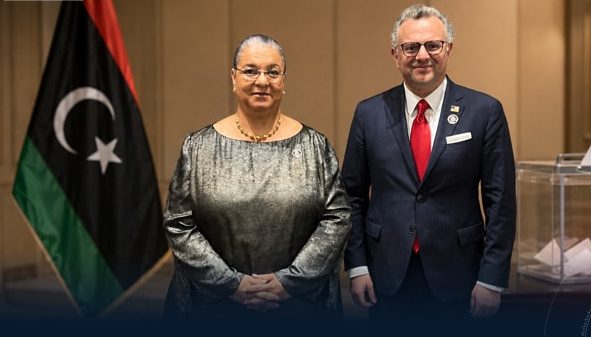
Libya – The Al Jazeera English program “Inside Story” discussed the prospects for success of an initiative led by Massad Boulos, senior adviser to former U.S. President Donald Trump on Arab and African affairs. The initiative, supported by Turkey, aims to unify Libya’s rival parties and institutions. Some observers question whether this diplomatic effort can end the conflict, given the failure of several similar international attempts in recent years.
The program featured political analysts Anas El Gomati, William Lawrence, and Murat Aslan. They debated whether diplomacy could bring peace in Libya, a country struggling with instability, deteriorating services, and deep political and institutional divisions.
El Gomati argued that Libya has become a battleground for global powers. Since the 2011 uprising, Libyans have hoped for a transition to a responsible, civilian, and democratic government. Instead, the country has seen seven transitional administrations and at least three internal wars. El Gomati said the main challenge is not only getting Libyans to agree, but also persuading key foreign powers to find common ground. He noted that some external actors are more willing to compromise than the local rival groups, who have fought repeated wars without true reconciliation. According to El Gomati, a severe lack of trust persists after 15 years without accountability, but Libyans have not completely lost hope for a political settlement.
Aslan stressed that understanding Libya requires recognizing the country’s unique social and psychological structures. Cities are central to Libyan identity, he explained, and tribal leaders, municipalities, and armed factions are especially influential in eastern and southern regions. Social cohesion depends on building a shared identity. He warned that clashing interests, identities, armed factions, and political currents often trigger crises. Yet, Libyan groups often return to dialogue and sometimes reach common ground, making Libya’s situation distinct and demanding a tailored approach.
Lawrence said the international community has made relative progress in Libya’s economic and security arenas, but political efforts have stalled. He noted that after a new roadmap was proposed for elections, discussions shifted this past June and July toward a fresh power-sharing agreement. The international community wants a unified and stable Libya for several reasons, including the war in Ukraine, tensions with Iran, and energy needs. However, Lawrence argued that the root challenge—building democratic and transparent self-governance for Libyans—remains unresolved.
El Gomati noted that elections are a key priority for Libyans, but questioned whether this goal is shared by the international community. He said Boulos’s current initiative has gained more momentum than previous efforts, but details are still unclear. Boulos has focused early talks on positions and power-sharing, without clarifying mechanisms, signatories, or next steps after forming a new government. El Gomati warned that ignoring or delaying presidential and parliamentary elections is a major risk.
He added that almost 2.8 million Libyans are eligible to vote, are registered for elections, and many have participated in local voting. Yet, they remain unable to choose their government or hold it accountable for poor services, especially in power, water, and healthcare. Forming a unified government, he argued, is not enough to ensure responsibility to the people. Libya also needs an effective judiciary, merit-based institutions, and a clear plan for elections.
Lawrence pointed to a main contradiction: Libya has significant wealth and qualified people, but cannot turn these advantages into development and stability. Libyans once hoped their country would become a prosperous, investment-friendly economy. He said a large portion of Libya’s wealth is secured in its sovereign fund for the future, and oil production is still below potential. Present revenues barely cover government expenses, while corruption and fuel smuggling remain problems. According to Lawrence, this dysfunction has caused widespread frustration and may push some Libyans to accept a power-sharing deal if it leads to economic improvements, but he cautioned that an unaccountable government will not deliver sustainable results.
Aslan said Turkey’s foreign policy has always aimed for a unified Libyan state, not further fragmentation. Ankara believes the top priority should be unifying institutions before holding fair elections, writing a constitution, and forming a stable government. Aslan said Libya has the shape of a state, but lacks integrated national structures across its regions. The real priority, he insisted, is building these institutions rather than starting from scratch.
El Gomati explained that the American plan did not begin by uniting the House of Representatives and the High Council of State, but by engaging the elites who control them. It led to progress on a unified budget. The main American demand is to let Libyan parties spend through a single framework, which could revive the economy. However, El Gomati said Boulos is not a traditional diplomat and that the American approach lacks a comprehensive management plan for the transition. Instead, it focuses on controlling the negotiations without real power-sharing or full integration of leadership structures.
Lawrence expressed concerns that conflict could return, even after about six years of relative calm interrupted by occasional clashes. He called for a new chapter with fresh leaders and technocrats, noting that Libya has sidelined many skilled individuals. He warned that any power-sharing deal that excludes key voices will not be sustainable. Aslan backed this view and said Turkey is focused on the end goal: a stable, unified government for Libya. He warned that dividing any country in the region risks triggering similar splits elsewhere.
The experts agreed that the Boulos initiative could temporarily unify Libya’s authorities and some institutions, allowing for joint economic and security measures. However, they cautioned that it is unlikely to produce a lasting solution without clear steps toward elections, accountability, reconciliation, and building institutions that function beyond elite power-sharing.