

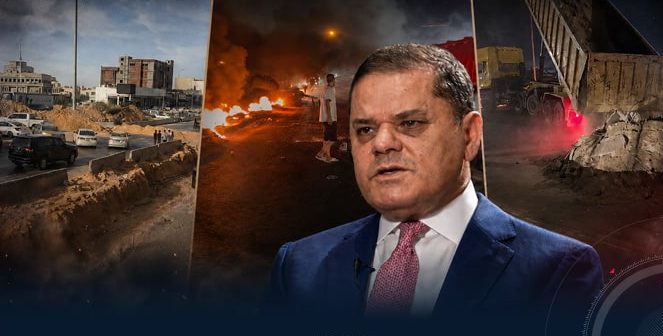
Tripoli – KAfa “Enough.” This was the word that echoed through the streets of western Libya on Tuesday, August 18, 2026, as years of anger erupted into mass protests. Blackouts, skyrocketing bread prices, fuel shortages, polluted water, a lack of medicine, cash shortages, and widespread instability fueled the demonstrations that swept from Tajoura and Shat Road in eastern Tripoli to Harsha in Zawiya, and from Awlad Talib and Tiji in the Western Mountains to Misrata.
Protesters set tires alight and blocked roads, venting frustration not at one single crisis, but at what they described as an “entire miserable life” forced upon them. The message was clear: patience with Prime Minister Abdulhamid Dbeibeh’s Government of National Unity was running out. Years of coping with division, corruption, militias, and collapsing services had exhausted the public’s tolerance for simultaneous crises.
Within a 48-hour span, large parts of western and southern Libya endured three waves of extended power cuts—some lasting more than ten hours per day—while a heatwave increased demand for electricity and water. The outages were not longer blamed on technical failures alone. Chronic insecurity and repeated attacks on power facilities, including during recent clashes, were major factors. The government was widely seen as responsible for the security vacuum that allowed these attacks, compounded by shortages of gas and the withdrawal of foreign companies.
Drone strikes in Zawiya darkened the situation further. Armed drones targeted key infrastructure, igniting fuel tanks—including one holding around 4.5 million liters of gasoline—and causing fires that forced the American company “GE” to withdraw engineers from vital power sites. These attacks exposed just how fragile Libya’s electricity and fuel networks have become, leaving millions vulnerable when security fails to protect essential lifelines.
A bitter paradox plays out in Libya, home to Africa’s largest proven oil reserves, yet citizens chase diesel tankers on the black market. The official price per liter is only 0.15 dinars, but during emergencies, consumers report paying more than eight dinars—a markup of over 5,233%. This enormous profit gap feeds smuggling networks, not state coffers. While smugglers buy cheap, subsidized fuel, bakers, farmers, public transport drivers, and ordinary citizens pay massive multiples, driving up prices for bread, vegetables, transportation, and nearly everything else.
Hanna Tetteh, the UN Secretary-General’s Special Representative, told the Security Council that Libya spends nearly $1 billion a month on importing fuel, yet power stations still run short. Much of this subsidized fuel is diverted, she said, leaving the government to pay while smugglers pocket the profits and ordinary people wait in line or buy at exorbitant prices.
The spike in bread prices has turned anxiety into daily fear inside many homes. Some bakeries raised the price of a single loaf to 750 dirhams (75 piastres), the highest in living memory, blaming rising flour and fuel costs and chronic electrical outages. Libya imports more than 90% of its wheat, making any disruption in supply or currency exchange rates a direct threat to family tables. Bread is not just another commodity—it is the final line of food security. When even this staple becomes scarce or unaffordable, and cash is unavailable because of liquidity problems, people know the crisis has moved beyond hardship into jeopardizing daily survival itself.
Food and water are now matters of trust as much as cost. Testing conducted by the prosecutor general found that about 65% of farm produce samples contained illegal pesticides or internationally banned carcinogens—some exceeding safe levels. Many citizens reported cutting back on fresh produce or avoiding eating it raw altogether.
Water contamination adds another layer of peril. A national survey led by the Statistics and Census Authority and UNICEF found E. coli bacteria in 46.4% of household drinking water, and 28% at the source nationwide. In some areas the contamination rate exceeded 70%, reaching 91.9% in Sirte, 85.1% in Jufra, and 72.4% in Murqub. This points to widespread recent fecal contamination, likely caused by leaking sewage, proximity of wells to septic pits, or dirty storage tanks. Residents often collect water relatively clean from the source, only for it to become contaminated at home—symptoms of persistent neglect throughout the water and sanitation system.
For cancer patients, the situation is dire. Despite announcements of new shipments of oncology drugs, shortages persist, treatment schedules are disrupted, and some patients are forced abroad if they can afford it, while others are left to wait. Investigations into the import of cancer medicines have exposed procedural and technical violations, showing the problem is not just one of empty warehouses but systemic failure. For patients needing carefully timed doses, a missed shipment can be more than an administrative error—it can be a death sentence.
While ordinary citizens queue for cash, groups of Syrian mercenaries recently held a protest outside the Police Academy in Tripoli over unpaid wages in dollars, according to the Syrian Observatory for Human Rights. Local videos showed armed men firing in the air. Deputy Defense Minister Abdulsalam Zubi reportedly intervened and promised payment. Official details remain scarce on how much money is owed or on what legal basis these foreign fighters remain in Libya.
This scene is part of a broader wave of anger, including demonstrations against irregular migration and perceived attempts to settle migrants in Libya. Many protest Libya’s policy of returning intercepted migrants to its territory rather than their countries of origin. For many, the migration issue has moved from a humanitarian or security concern to a question of sovereignty, demography, and whether the state can truly police its borders.
The image is stark: foreign mercenaries demand dollar salaries at gunpoint, while Libyan citizens cannot withdraw their dinar wages or buy a loaf of bread. Fears are rising about the continued presence of thousands of irregular migrants, especially as authorities under the Dbeibeh government forcibly return those intercepted at sea.
Militias have dominated life in Libya for nearly 15 years. Since 2011, governments have come and gone, while armed groups continue to wield weapons, close roads, block institutions, and control key state functions. Efforts to disband these groups or create a professional army and police have repeatedly failed. In Dbeibeh’s era, armed influence has extended deeper into economic and administrative affairs, giving these groups power over ports, airports, fuel, contracts, and state decisions.
Corruption is fueled by a lack of transparency. Accusations swirl about fraudulent credit lines, smuggling of subsidized goods, unchecked public spending, and the monopolization of state contracts—especially in sectors like communications and fuel. Without full disclosure on who benefits, how contracts are awarded, and where the money goes, suspicions thrive and confidence in the government collapses.
In the days leading up to August 18, roads in Tajoura, Shat Road, and southern Tripoli were closed by protests. Demonstrations also hit Harsha in Zawiya, as well as Awlad Talib and Tiji in the Western Mountains, all focused on deteriorating services and living conditions. Tires burned, slogans rang out, and more areas warned they might join the unrest.
These protesters were not demanding special privileges. They asked only for reliable electricity, clean water, accessible fuel, affordable bread, available medicine, cash from banks, and roads free from militia checkpoints—the most basic functions of any state, now reduced to a wish list in Libya. As the movement became more political, chants directly blamed the Dbeibeh government for worsening conditions. Protesters shifted from asking “When will electricity return?” to “Why is this government still here?”
In Misrata, Dbeibeh’s hometown, a protest tent in front of the municipal council stood as evidence of rising anger, focused in part on the upcoming “Al-Arar” festival planned for August 18–22. Social media claimed the festival’s budget surpassed 70 million dinars, though no audited figures were published. For many, the sight of lavish festival preparations in a city suffering blackouts and empty pantries was a provocation, highlighting the authorities’ failure to communicate or justify their spending priorities.
Year by year, Libyans have been forced to become their own state. They purchase generators, water tanks, black-market fuel, medicines from abroad, private schooling and healthcare, and even hire guards for shops and neighborhoods. Many must pay a premium just to withdraw their wages, and cope without support despite living atop one of Africa’s richest oil reserves. When all appeals and patience are exhausted, blocking roads becomes the last and most desperate call for help—an act that signals the collapse of all other channels for citizen accountability.
For Libya’s people, the question is no longer whether the Dbeibeh government can contain the anger, but how much longer citizens must pay for state failure. They had no share in arms deals, no hand in corrupt contracts, nor any benefit from smuggled profits—but they bear the highest cost.
As protests spread, it is not because the public has lost control, but because the government long ago lost its hold on its basic responsibilities. When burning tires become the only way people can prove that they exist, the problem is not in the people’s anger, but in authorities who fail to hear their suffering until it turns into an outcry.
The “Enough” slogan now stands as a reckoning—a verdict on broken promises and a government that has run out of public trust. After years of endurance, Libyans say they have nothing left to lose. No fuel, affordable bread, safe water, reliable medicine, cash, or safety. As the Dbeibeh government fails to protect what many now call a “miserable” way of life, more and more Libyans see their only option as reclaiming their rights themselves. The “Enough” movement may signal the beginning of the political end for a government that left behind a wrecked nation and citizens drained by need.