

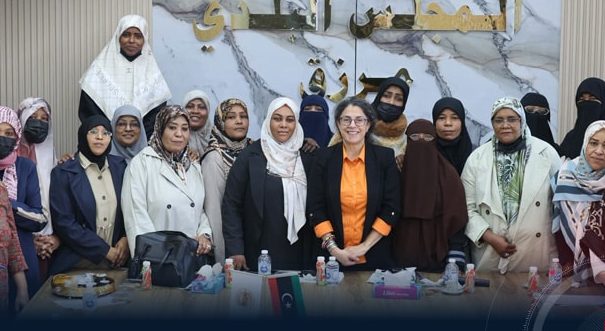
Murzuq – Deputy Special Representative of the United Nations Secretary-General for Political Affairs Stephanie Khoury visited Murzuq on Thursday to discuss developments in the political process, including the outcomes of the mini-meeting agreement and structured dialogue. She listened to the priorities and challenges facing local residents at the conclusion of her visit to southern Libya.
Khoury and her delegation were welcomed by Murzuq mayor Ashraf Adam and members of the municipal council. Several mayors and municipal officials from the Murzuq basin, academics, a member of the House of Representatives, representatives of the structured dialogue and advisory committee, as well as civil society activists attended. Speakers noted improvements in security in the south.
The discussions focused on Murzuq’s efforts to overcome the impact of conflict and promote community reconciliation. Participants highlighted local initiatives that have strengthened peaceful coexistence and stability, but also pointed out ongoing challenges and called for effective political representation.
Women from the region outlined their priorities for peace, service delivery, and economic empowerment. They called for a shift from temporary aid to sustainable, locally designed programs that consider the social and economic realities of the Fezzan region. The women also urged continued support from local authorities to provide specialized services for children with disabilities, improve basic services, support displaced families, create economic opportunities for women, and provide safe spaces and stronger protection measures. They emphasized the need for active participation in peacebuilding and the political process.
The UN mission opened channels for future engagement with a broader group of young people from the Murzuq basin and plans to hold a meeting with them soon.
At the end of the day, the delegation met with local security officials to discuss security conditions in Murzuq and across the south. Talks focused on border security and cross-border challenges, such as irregular migration and drug trafficking. Security representatives stressed the need for enhanced coordination between security institutions, greater operational cooperation with neighboring countries, and said political unification should come before any integration of security institutions. They also highlighted the importance of fostering a secure environment to support the political process and future elections.
In a separate meeting, representatives from the Development and Reconstruction Fund, a member of parliament, a group of women, and the UN delegation reviewed the achievements of the Development and Reconstruction Fund in Murzuq so far. Ahmad al-Nemr, responsible for overseeing projects in southern Libya, responded to women’s concerns about rehabilitating neighborhoods and improving water and hospital services in Murzuq to help ease the return of families to the area.
The UN visit provided an opportunity to hear directly from local authorities and communities about progress, ongoing challenges, and the support needed to improve living conditions. The mission detailed updates on the UN-sponsored political process in Libya.