

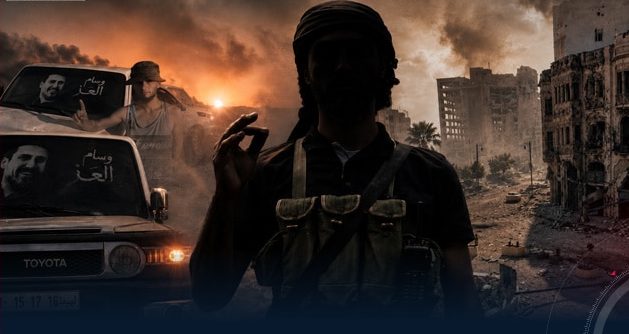
Benghazi – The appearance of images of Wissam bin Hamid on the windows of cars participating in the “Ar’arar Rally” in Misrata has sparked anger among many in Benghazi and eastern Libya. For thousands of families in the region, the image is not simply a nostalgic tribute, but a reminder of a dark period marked by assassinations, bombings, neighborhood wars, and years of living in fear.
A Facebook page bearing the name of Al-Naba TV described the photo and the number “01” on rally cars as a “symbolic presence of the martyred leader of the Benghazi Shura Council of Revolutionaries.” The event was officially secured, and Prime Minister Abdul Hamid Dbeibeh attended. No public statement was issued at the time regarding the entry of these vehicles or the authorities’ position on glorifying a figure linked to terrorist organizations banned both locally and internationally.
Wissam bin Hamid was formerly the leader of “Libya Shield 1” before becoming the military commander of the Benghazi Shura Council. The council, formed in 2014, was a coalition that included Ansar al-Sharia, an al-Qaida-aligned group designated as a terrorist organization by the UN Security Council, along with the Rafallah al-Sahati and the February 17th Martyrs brigades, and other armed factions.
Bin Hamid appeared in videos alongside Ansar al-Sharia leader Mohammed al-Zahawi and foreign fighters. The council was not a political group; it functioned as an armed force that fought inside Benghazi, allied with Ansar al-Sharia and ISIS. Bin Hamid was seen celebrating with Al-Zahawi after seizing special forces bases, vowing to keep fighting until what he called “God’s law” was established.
A year before the Benghazi war erupted, bin Hamid’s name became infamous during one of the city’s bloodiest episodes. On June 8, 2013, protesters gathered outside the “Libya Shield 1” headquarters, demanding armed militias surrender control to the army and police. The protest turned violent when Shield forces opened fire with heavy weapons and anti-aircraft guns, killing 32 people in what became known as “Black Saturday.” Cameras captured bin Hamid firing live ammunition at demonstrators. No official accountability for the massacre followed, until the Libyan Armed Forces retaliated years later.
A 2016 UN Panel of Experts report cited strong evidence that “Libya Shield 1,” under bin Hamid’s command, carried out assassinations of activists, orchestrated bombings, and recruited foreign laborers as operatives in Benghazi. Ansar al-Sharia, a main council component, was responsible for multiple attacks against security forces from 2011 to 2014, with hundreds of casualties. Bin Hamid was deeply entwined with this group, sharing leadership, arms, and training camps.
While the Benghazi war involved violations and widespread destruction affecting civilians, observers warn against equating perpetrators with victims or overlooking bin Hamid’s direct role in the city’s devastation. Human Rights Watch documented shelling by groups under the Benghazi Shura Council that killed and wounded civilians and destroyed homes. These groups, together with Ansar al-Sharia and ISIS, entrenched themselves in neighborhoods such as Sabri, Souq al-Hout, Leithi, Gwarsha, and Qanfouda. They turned streets and houses into barricades and ammunition depots, leaving entire districts in ruins.
Weapons supplies to bin Hamid were not a secret. Nouri Abu Sahmain, former head of the General National Congress, later admitted he knew that boats were transporting light arms to support bin Hamid, as well as other militia leaders. In a widely circulated video, Misrata tribal leader Hamid Khuder said he once asked bin Hamid if some of these shipments reached ISIS fighters in Benghazi. Bin Hamid allegedly replied: “Of course, because they’re holding the Leithi front for us.” He reportedly justified it by saying, “Anyone fighting Haftar, I’ll fight alongside.”
Other testimonies, including from figures once opposed to the Libyan National Army, confirmed bin Hamid’s alliance with ISIS. On December 13, 2017, Noman Benotman, then-president of the Quilliam Foundation, told Libya Al-Ahrar TV that the CIA had verified bin Hamid’s allegiance to ISIS. Benotman said he was “convinced without any doubt” that bin Hamid pledged loyalty to ISIS during a brief trip to Syria in 2015. Abdelrazak al-Aradi also stated bin Hamid had declared a “bay’a of combat” to ISIS during a meeting in Misrata. These admissions were made by those opposed to the LNA, lending them added credibility.
For the families of soldiers, police, judges, activists, and civilians killed in Benghazi, bin Hamid’s image is not just a political statement. It feels like reviving the memory of a bloody chapter and honoring its architect. It stirs pain for mothers who lost sons to assassination, for families who returned home to find only rubble, and for the wounded who remain scarred by a war that ended in headlines but not in their lives.
The impact of the image spreads beyond Benghazi to Derna, whose people endured ISIS rule, executions, and assassinations, as well as to the wider east, which suffered years of terrorism. Victims see not just one man in the photo, but an array of partners, flags, car bombs, and ammunition shipments.
Returning to Misrata, where bin Hamid’s images were displayed, the city paid a heavy price in the 2016 battle to free Sirte from ISIS. The final tally announced for the “Al-Bunyan Al-Marsous” operation was 730 dead and over 6,000 wounded, including many amputees and people left paralyzed who needed ongoing support. Most fighters were from Misrata, according to Reuters.
These casualties were absent from rally celebrations. Some young men returned home in coffins, others returned with life-altering injuries, all to prevent ISIS’s flag from flying just hours from their city. How, then, can an image of a man who pledged allegiance to ISIS be displayed on Misrata’s streets, among its people and its wounded, as if none of this had happened?
If Misrata, the city of “Al-Bunyan Al-Marsous,” can forget Sirte and those left disabled by ISIS, who will remember? If an image of an ISIS ally passes before the eyes of security officials in the very city that ousted the group, then maybe the military battle is over, but the fight over memory continues.
With the vehicles participating in an official, government-secured event attended by the prime minister, the Ministry of Interior and Misrata’s Security Directorate are obliged to clarify what happened. They must find out who displayed these symbols, whether they did so knowingly, and state their stance on the glorification of leaders of groups connected to terrorism.
Terrorism does not always reappear with suicide bombers or car bombs; sometimes it resurfaces as a glossy photo on a car window, exploiting short memories and silent institutions. When a leader of a period of bloodshed and ruin is allowed to become a symbol, victims feel as if they are killed twice: once by arms, and again by oblivion.