

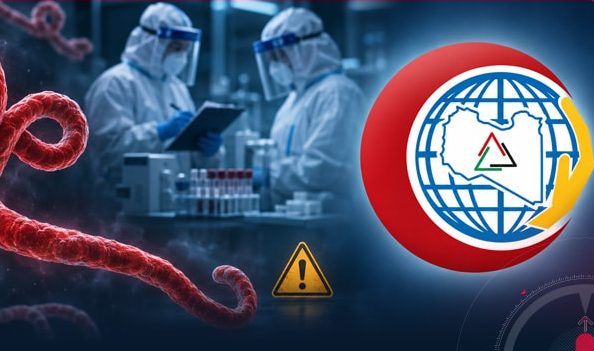
The National Center for Disease Control announced that no confirmed or suspected cases of Bundibugyo Ebola virus have been recorded in Libya to date. The center continues to monitor outbreaks in several African countries and is increasing readiness for early detection and rapid response.
The center emphasized that it is closely following developments regarding Ebola outbreaks in parts of Africa through both national and international surveillance channels. It is coordinating efforts with relevant health authorities.
Ebola is classified by the center as one of the most dangerous viral hemorrhagic fevers, posing a direct and urgent threat to life. Death rates are high without immediate medical intervention and early isolation.
As of this statement, Libya has recorded no confirmed or suspected cases. The epidemiological situation in the country remains stable. Surveillance and rapid response teams are on heightened alert, enhancing monitoring measures and preparedness to detect and respond to any suspected cases according to established protocols.
The center reported that the outbreak is expanding and not yet controlled. The current Bundibugyo strain outbreak began in the Democratic Republic of Congo in May 2026. This is the largest outbreak for this strain and the second largest Ebola outbreak ever recorded.
According to the World Health Organization’s latest reports:
– A total of 9,668 confirmed cases and 4,649 deaths have been reported so far. Nearly half of confirmed cases in Congo have died (4,646 deaths out of 9,637 cases, or 48.2%).
– The outbreak is accelerating again, with 1,466 new cases in the past 21 days compared to 1,328 in the previous period (a 10.4% increase) and deaths rising from 644 to 692.
– The disease has crossed borders, with cases now in Kenya (9 cases, 8 newly detected) and Nigeria (1 case). Past spillovers into Uganda and France have ended, but infected travelers may bring the virus to new countries before being diagnosed.
– More than 31,000 contacts are under monitoring. Sixty-six health zones in eight provinces are affected, with Ituri the hardest hit.
– Healthcare workers have also been affected, with 301 infections and 48 deaths reported among medical staff.
– No licensed vaccine or treatment currently exists. The situation is made more complex by insecurity, population displacement, and obstacles to humanitarian access.
The center explained that the virus spreads through:
– Direct contact with the blood or body fluids (saliva, sweat, vomit, or other secretions) of an infected person, even if symptoms are mild.
– Contact with surfaces or items contaminated by patient fluids, such as clothing or bedding.
– Close contact with travelers from outbreak areas without proper protection, or participating in unsafe burials of those who died from the disease.
– Handling infected animals, bushmeat, or contact with monkeys and bats.
The disease does not spread through casual contact with asymptomatic people. Diagnosis is only confirmed by laboratory testing (PCR).
Warning symptoms appear suddenly, typically two to 21 days after exposure. Early symptoms can resemble other illnesses but deteriorate quickly and include:
– High fever with severe headache.
– Intense muscle and joint pain with extreme fatigue.
– Sore throat, followed by severe vomiting and watery diarrhea.
– Rash and severe impairment of kidney and liver function.
– In advanced cases, unexplained internal or external bleeding (from the gums, eyes, nose, or blood in stool).
The center issued strict warnings to travelers and close contacts. It said that failing to report symptoms, or concealing travel history to outbreak countries, endangers not only the individual but also family and the wider community.
Travelers to high-risk countries (Democratic Republic of Congo, Kenya, Nigeria, and neighboring nations such as Uganda, South Sudan, Somalia, and Djibouti) should avoid travel unless absolutely necessary. Tourism, recreation, or routine business visits are strongly discouraged.
If travel is unavoidable, travelers are advised to avoid contact with anyone showing fever or fatigue, avoid touching any blood, body fluids, or corpses, and stay away from caves, mines, and rainforests. Frequent handwashing with soap and water or alcohol-based sanitizers is advised.
All travelers entering through land, sea, or air must promptly and transparently inform international health control teams about their point of origin and report even mild symptoms.
Anyone who has had contact with travelers from outbreak areas should monitor their health closely for 21 days. If a fever or unusual symptom appears, the person must isolate immediately in a separate room, avoid contact with family, not go to clinics randomly, and first call the hotline for safe transfer.
For institutions, the center circulated these recommendations to the Ministry of Foreign Affairs, diplomatic missions, Ministry of Sports, Olympic Committee, Sahel-Sahara Bank, the Islamic Call Society, and others. It asked that visas for people from or passing through these countries in the previous 21 days be delayed unless essential, with coordination at least 48 hours before arrival, and urged postponement of non-urgent visits, including delegations, teams, and sporting events.
The center urged citizens and residents to rely solely on official sources for information and to avoid sharing unverified news or rumors. Any updates on the outbreak situation will be announced through the center’s official channels. It stressed that the first line of defense against this deadly virus is public awareness and strict adherence to guidelines.
The center called for immediate communication via hotline 195 or 0911959988 for questions or to report any suspected case.