

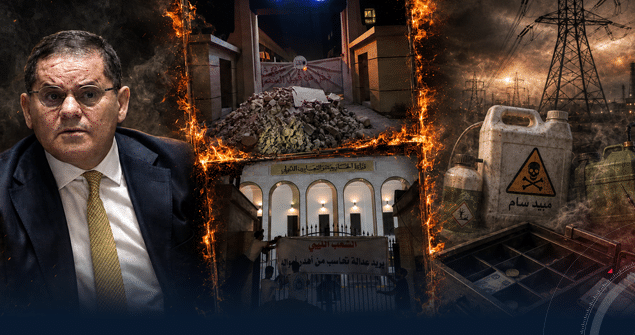
Tripoli – On Sunday night and early Monday, protesters in several Libyan cities took to the streets, not just to demand the return of electricity to their homes, but to declare that the government of Abdulhamid Dbeibah had lost legitimacy. Frustration erupted after the national electricity company repeatedly warned the government about the imminent collapse of the grid, fuel shortages, and gas supply problems, only to see the crisis escalate further. Prolonged blackouts, some lasting more than 14 hours, left many neighborhoods in darkness—an unprecedented situation in the past two years according to the government’s own records.
Anger quickly spread from Tripoli districts like Souq al-Jumaa, Tajoura, Ain Zara, Janzour, and Al-Zawiya to other key towns along the western coast, eventually reaching Misrata—Dbeibah’s birthplace and a major political and military stronghold for his government. Protesters no longer called for the government’s future resignation; many claimed it had already fallen and began organizing local committees to run their areas independently.
Nighttime demonstrations in neighborhoods such as Tajoura, Souq al-Jumaa, Al-Siraj, Janzour, Zawiyat al-Dahmani, and Al-Dhahra involved tire burnings and road blockades. Protesters blamed the Dbeibah government for persistent electricity cuts, water shortages, inadequate healthcare, surging prices, inflation, and cash deficits.
The unrest soon reached government buildings. Barricades sprang up outside the Ministry of Foreign Affairs, the National Audit Bureau, and Libya’s National Communications Holding Company. Offices of major telecom firms ‘Libyana’ and ‘Almadar’ and branches of the Central Bank in Souq al-Jumaa were shut down, signaling the start of a civil disobedience campaign aimed at paralyzing Dbeibah’s government institutions, but taking care not to harm citizens or vital humanitarian services.
In Tajoura, the local movement declared its participation in a general civil disobedience strike with the goal of bringing down the government. In Ain Zara, main roads were blocked, while in Janzour, protesters erected barricades near the 17 Bridge, closing the coast road. Demonstrations spread to key entry points to the capital, including Nobras and Ghiran islands, close to government headquarters. Activists clarified that the first stage of their civil disobedience would focus on disrupting government agencies and state companies, not on harming ordinary citizens.
In Al-Zawiya, protest leaders announced a peaceful strike, suspending work in public institutions and facilities, except for hospitals, medical centers, and emergency services. They emphasized non-violence, insisting that no roads or properties should be targeted. Protest demands had also shifted—from fixing the electricity crisis to ousting the Dbeibah government, prosecuting officials for corruption, tackling the currency collapse, and addressing healthcare, fuel, and water shortages. Protesters declared the government void in Al-Zawiya and called for actions that would prevent any pretext for a security crackdown.
Al-Zawiya’s stance is particularly significant. The city’s power station had already been damaged in previous clashes, causing the network to lose about 700 megawatts and prompting the withdrawal of American GE engineers. The government was thus seen as doubly responsible: failing to safeguard key infrastructure and to secure critical personnel, while the Interior Ministry’s inaction added to the frustrations.
The most symbolic development came from Misrata. Protesters stormed the municipal council building, meeting with the city’s mayor and telling him the Dbeibah government “had fallen” locally. They authorized the mayor to take over the city’s affairs independently. Demonstrators demanded protection of local institutions and insisted that municipal authorities secure the local radio station to prevent it being used by Dbeibah’s administration. Protesters set up tents for an open-ended sit-in outside the council offices, stating that the mayor was now the sole authority for the city.
The spread of protests to Misrata, a stronghold for Dbeibah, marked a turning point. Unlike unrest in other cities, where the government could claim traditional opposition involvement, the events in Misrata showed that popular support for Dbeibah is collapsing even in his base.
In Libya’s western coastal region, protests escalated as demonstrators stormed the Mellitah Oil and Gas Company complex and announced its closure, demanding Dbeibah’s ouster and blaming his government for ongoing gas exports amid widespread power shortages. No official statement was issued by Mellitah or the national oil corporation about the impact. Protesters noted that Mellitah processes gas for export to Italy, even as Libyan power plants are starved of supply. The electricity company had previously asked to halt exports to Italy and redirect gas to local power stations but received no reply.
Records show the national electricity company issued formal warnings more than a month before the blackout crisis. On June 4, 2026, company director Abdullah Hammouda urgently appealed to Dbeibah, the attorney general, and officials, warning of severe shortages in natural gas and fuel that threatened the stability of the national grid. The company reported the loss of over 1,000 megawatts in generation capacity and predicted partial or total blackouts if shortages continued, declaring the company was not responsible for resulting technical and economic damages. The warnings were made public by June 5, pre-dating the full-blown crisis by weeks.
Insiders told Al-Marsad that the company did not want to alarm the public after three years of relative stability, but it officially warned Dbeibah and the attorney general and requested the government’s intervention, especially asking to temporarily halt gas exports to Italy—a request that went unanswered.
Earlier warnings had been issued by oil sector officials. In April 2024, a document from then-National Oil Corporation chairman Farhat Bengdara predicted the exact electricity shortages for 2026, attributing them to insufficient gas for power stations. These warnings indicate that the current crisis is not just the result of unexpected breakdowns, but of chronic government inaction despite clear foresight.
Instead of responding to the electricity company’s urgent warnings, Dbeibah deflected blame onto the utility company, calling its management “incompetent and corrupt.” However, he did not address why the government failed to secure fuel and gas supplies or declare an emergency as heatwaves intensified. The government’s assertions about project spending raised more questions about where the money had gone when plants lack fuel to operate.
While there were contributing technical issues, such as power line breakdowns, plant damage, and the withdrawal of foreign engineers, the public sees primary responsibility resting with Dbeibah’s government, which oversees coordination between the oil and electricity sectors, secures supply chains, and responds to urgent warnings. The public also rejects attempts to blame the company alone, given government preoccupation with political infighting and unrest in the south. The government was explicitly warned but failed to act.
The crisis, which began as an electricity dispute, exposed deeper anger over water cuts, inadequate health services, inflation, cash shortages, persistent corruption, delayed elections, and growing poverty—most recently seen in a scandal over toxic fertilizers. As power cuts stretched for more than half a day during a punishing heatwave, the public saw a wealthy oil state unable to light its own cities while continuing to export gas abroad.
The protests therefore escalated from demands for improved services to outright rejection of Dbeibah’s authority. Local committees began assuming functions of the government in affected areas, closing its offices, and demanding new leadership capable of organizing national elections.
Dbeibah’s government, for its part, did not issue a clear political or practical response to the growing unrest or set out a timeline for restoring electricity. The first official statement came from the prime minister’s security team, warning against attacks on state property and vowing to uphold order. Meanwhile, Youth Minister Haitham al-Zahaf announced a program to distribute 6,000 housing loans, which protesters dismissed as an inadequate gesture, even shutting down the ministry’s offices in eastern Tripoli.
Sunday night’s protests were more than just another outcry over power outages. The demonstrators withdrew recognition from Dbeibah’s government and began shutting it out from key cities—Tripoli, Al-Zawiya, Misrata, and the western coast. Internal documents revealed that both the electricity and oil sectors had repeatedly alerted the government to the risks, contradicting claims of a sudden crisis. The protests have since grown into a rejection of not only Dbeibah’s leadership but of the current political order, amid continuing government silence on repeated warnings it had received well before the crisis unfolded.