


The year 2025 witnessed a pivotal shift in the structure of Libyan border security and national defense. This transformation centered primarily around re-engineering the military institution in the east and south of the country under the leadership of the “Libyan Arab Armed Forces”.
At the heart of this transformation, Deputy Commander-in-Chief of the Armed Forces, Lieutenant General Saddam Haftar emerged. He acts as the chief architect of the new security and political strategies. This became evident particularly after assuming the positions of Deputy Commander-in-Chief and Chief of Staff of the Land Forces.
In this context, the file of illegal migration is no longer merely a passing security challenge or a humanitarian crisis. Instead, it has transformed into a fundamental pillar of “Vision 2030” launched by the General Command. Moreover, this strategy serves as an effective geopolitical tool to redraw international alliances—specifically with influential regional powers such as Turkey and Italy. Furthermore, it aims to consolidate domestic legitimacy by controlling the political economy of Libyan border security.
This report reviews, based on field data and international reports, the features of the new strategy and its effects on the ground.

Institutional Modernization… Building on Gains
The appointment of Lieutenant General Saddam Haftar as Deputy Commander-in-Chief and Chief of Staff of the Land Forces represented a pivotal step in the development path of the National Army.
This shift was not merely a hierarchical procedure; rather, it came as the culmination of years of efforts to rebuild the military institution and an announcement of the launch of an advanced phase of “Institutional Modernization” and “Centralization of Decision-making.”
Within “Vision 2030,” this phase aims to transition military units from a system of support formations to modern regular armies. Specifically, the goal is to integrate field expertise into a unified institutional framework. This structure will be capable of dealing with complex regional challenges with high efficiency and professionalism.
This direction was evident in the intensive meetings held by the Deputy Commander-in-Chief with security leaders (Ministry of Interior, the Illegal Migration Control Agency, and the National Security Advisor). These resulted in the formation of specialized high-level committees to manage sovereign files instead of individual improvisation, including:
A committee to regulate the visa file and legalize the entry of foreigners through official ports.
A committee to combat smuggling in all its forms (fuel, food, medicine) to protect the citizens’ food security.
A committee to develop the Anti-Illegal Migration Agency and overcome the difficulties facing its work.
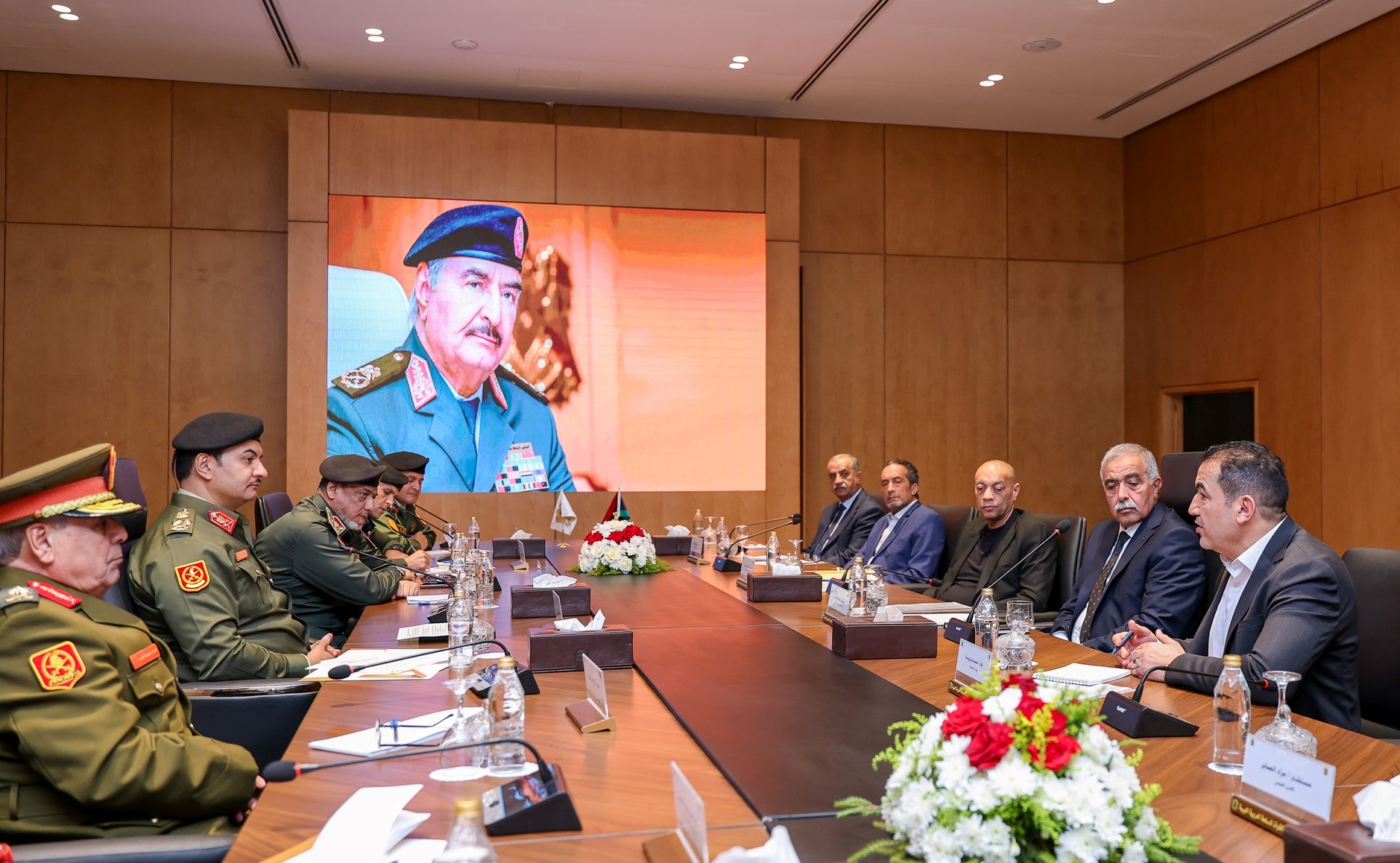
This structural transformation allowed the General Command to impose more precise control over vast border areas and convert units deployed in the south and east into an integrated operating system subject to a central operations room, thereby enhancing the speed of response to threats compromising Libyan border security.
Regional Crisis Management
The war in Sudan constituted a test of the Libyan state’s ability to protect its national security without abandoning its humanitarian role.
“Security Containment” Strategy
Data from the International Organization for Migration (IOM) in its report for the third quarter of 2025 indicates the success of Libyan measures in reducing irregular migration flows across the border triangle.
In particular, the organization attributed this to sovereign decisions to close the “Al-Awaynat” crossing and intensify desert patrols, which led to a decline in the activity of smuggling networks that attempted to exploit the security vacuum in neighboring countries.

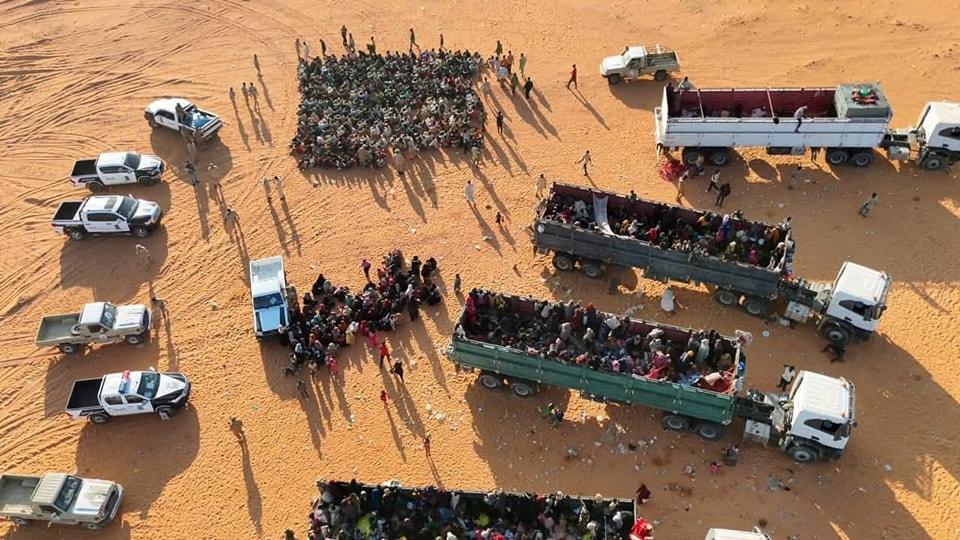
Contrary to previous reports, the Armed Forces did not limit themselves to security closures. They intervened through Border Guard units in qualitative rescue operations, as occurred in June 2025. The goal was to liberate Sudanese families stranded in the border triangle who were subjected to extortion by external armed gangs.
Subsequently, the displaced were transferred to the city of Kufra and handed over to competent agencies (Red Crescent, Health, Migration Agency) to provide medical care. This was confirmed in official discussions with the UN envoy, where mechanisms for voluntary return were agreed upon in coordination with the United Nations.
Between Security Firmness and Humanitarian Duty
The city of Kufra presented a model for effective coordination between security agencies and service sectors:
Health and National Security: In order to control the demographic presence, the Armed Forces supervised a comprehensive census system. Consequently, this resulted in the issuance of more than 164,500 health certificates for refugees. Ultimately, this serves as a proactive step to protect the health security of citizens.
Field Unit Discipline: Military units stationed in the region, primarily the “Subul al-Salam Battalion,” showed remarkable development in their professional performance.
This was evident in a qualitative operation carried out in November 2025. They succeeded in liberating Libyan citizens kidnapped by armed gangs deep inside Chad. Returning them safely confirmed their commitment to protecting citizens as a top priority, far from any tensions.
Libyan Border Security Diplomacy and Joint Forces
In the southwest, the strategy shifted from mere “surveillance” to “security partnership” and imposing sovereignty:
Joint Force with Chad
In a proactive move to control the borders, a joint military force was activated between the General Command and the Chadian Army. This activation occurred in November 2025 under direct directives from the Deputy Commander-in-Chief. As a result, desert patrols began securing the border strip from bandits, reflecting an evolution in combat doctrine toward “Regional Cooperation.”
Field Presence
The General Command reinforced its presence at advanced border points. Deputy Commander-in-Chief of the Armed Forces, Lieutenant General Saddam Haftar conducted inspection tours. Furthermore, these included “Border Crossing 17,” the Waw al-Kabir base, Essien crossing with Algeria, and the “Al-Tum” crossing with Niger. The goal was to assess unit readiness and equip them with technologies to ensure full control over smuggling routes.
Security as a Lever for the Economy
On the eastern coast, the security vision integrates with reconstruction projects, where the migration file is approached from an economic perspective.
Labor Market Regulation: For instance, International reports (DTM) monitored a shift in migration movement toward “circular migration” and seasonal migration, meeting the needs of reconstruction projects in the east of the country.
Therefore, The General Command seeks to legalize this labor force (especially Egyptian and Chadian) to ensure their rights and utilize them in the development cycle.
The security vision has integrated with development projects in the east of the country.
Security authorities are dealing with expatriate labor from a perspective of “regulation” rather than “exclusion.” They are seeking to legalize expatriate labor to serve reconstruction projects. Simultaneously, they strike with an iron fist against human trafficking gangs.
Combating Organized Crime: Parallel to regulation, security agencies are striking hard against human trafficking networks.
The Imsa’ed area witnessed a broad security operation that liberated 570 migrants from the grip of smugglers. It also resulted in the destruction of the infrastructure of smuggling dens. This reflects zero tolerance for any activities affecting the rule of law.
Security Diplomacy… Diversifying Strategic Partnerships
The Chief of Staff of the Land Forces succeeded in formulating a new diplomatic doctrine based on “diversifying partners” to serve national interests and enhance Libyan border security.
Political Realism with Turkey
The year 2025 witnessed a remarkable development in relations with Ankara, culminating in official visits by Lieutenant General Saddam Haftar and meetings with the Turkish Foreign and Defense Ministers.
Notably, discussions focused on exchanging military expertise, localizing defense technology (drones), and intelligence cooperation to control borders, in a step reflecting political maturity and prioritizing supreme national interest.
Development Partnership with Europe
The relationship with Italy and the European Union moved beyond the traditional security dimension. During meetings in Benghazi and Rome, Lieutenant General Saddam Haftar proposed a comprehensive approach linking “combating migration” to “spatial development” in the south.
He explicitly called on European companies to invest in infrastructure as a radical solution to the root causes of migration, rather than settling for security solutions.
Openness to International Institutions
The Armed Forces proved to be a reliable partner for the international community. This was clearly evident in meetings with the United Nations Support Mission in Libya (UNSMIL). The political roadmap and voluntary return files were discussed. This confirms the military institution’s commitment to the political path and international legitimacy.
SRSG @HannaTetteh, accompanied by DSRSG for Political Affairs, met today in Benghazi with Field Marshal Khalifa Haftar, Commander of the Libyan National Army (LNA), and his deputy, Gen. Saddam Haftar.
Discussions focused on the UN’s proposed political roadmap leading to national… pic.twitter.com/FA1q66kSnd
— UNSMIL (@UNSMILibya) September 7, 2025
Indicators from 2025 show the Libyan military institution is succeeding through its new structure. It presents a “Strong State” model capable of controlling borders and building balanced international partnerships. This strategic shift restores Libya’s status as an active partner in Mediterranean and North African stability.