

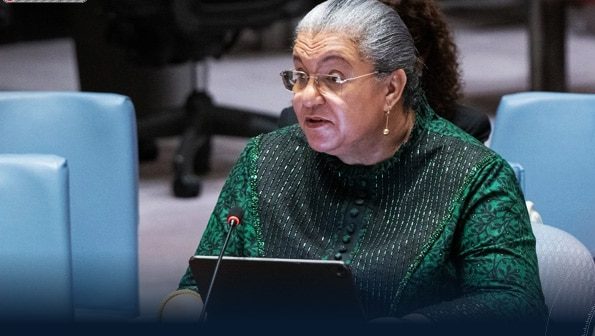
The United Nations Special Representative for Libya, Hanna Tetteh, said a political agreement signed at a mini-summit in Tripoli on August 30, 2026, has created an opportunity to break the country’s political deadlock. The deal outlines a path for holding presidential and parliamentary elections under a unified executive authority within 24 months. Tetteh also warned of the negative effects of continued division on Libya’s economy, security, and daily life.
In a briefing to the UN Security Council on October 14, Tetteh noted progress made after four months of talks but cautioned that Libya’s institutions must cooperate and the international community’s support must continue to prevent spoilers from derailing the political process.
She said the August 30 agreement and roadmap were widely welcomed inside and outside Libya. The plan received formal support from the UN Security Council on September 8, as well as endorsements from the Government of National Unity, the Libyan National Army, the House of Representatives, Deputy Presidential Council head Musa Al-Koni, and others. This support shows broad recognition that ending political paralysis and unifying institutions is necessary so elections can produce leadership capable of addressing Libya’s challenges.
The agreement calls for restructuring the board of the High National Elections Commission and resolving longstanding constitutional and legal disputes that have threatened credible and inclusive elections. Its roadmap aims to hold presidential and parliamentary votes under a unified executive within 24 months.
On the electoral commission, Tetteh said consensus on its new board was achieved based on earlier decisions from both the House of Representatives and the High Council of State. Geographic balance in choosing the commission head was prioritized to ensure wider representation. Tetteh praised the constructive approach of both the current and incoming boards, expressed confidence in a smooth handover, and reaffirmed the UN’s readiness to provide technical support.
The agreement requires approval from both the House of Representatives and the High Council of State within a month of signing. The UN encouraged both bodies to ratify the deal, even allowing for reservations that could be addressed later in the legislative process. The House of Representatives ratified the agreement on September 14 after 103 members signed a supporting statement in August. On September 28, the Speaker informed the UN that related laws and amendments had been passed, including those forming the new election commission board. Tetteh stressed that all legal steps must align with the spirit of consensus from the mini-summit.
However, the High Council of State rejected the agreement and the corresponding laws on October 5, citing concerns over possible breaches of constitutional and legal frameworks and the balance of powers between the two chambers. Tetteh expressed regret at the council’s rejection, saying it reflected the limited willingness among some members to engage constructively. She added that some council members did want to participate and have requested more time to consult on next steps.
Tetteh said Libya cannot allow spoilers to disrupt the political path and promised to provide further updates on outreach to the High Council of State at her next UN briefing. She plans more consultations with mini-summit participants later in October, including discussions on setting up a more broadly representative national mechanism, as outlined in Article 5 of the agreement and in consultation with the UN Security Council.
The mini-summit is not the only mechanism for moving forward. She said that elections are inseparable from Libya’s wider institutional crises, especially the division in the judiciary. She welcomed the readiness of stakeholders to work with Libyan legal and judicial experts to address this and ensure judicial independence for credible elections.
The UN mission will continue consulting with various Libyan groups on unifying institutions and preparing for elections, drawing from the advisory committee’s recommendations and ongoing structured dialogue. The mission will also maintain coordination with regional and international partners to support a unified, Libyan-led political process.
Tetteh also addressed recent changes in the leadership of the House of Representatives. On October 5, the House amended its internal regulations to allow for annual rotation of its leadership. The next day, with 111 members present, it held elections for a new board, electing Saleheen Abdel Nabi as Speaker. Tetteh congratulated Abdel Nabi and his team, expressed the UN’s readiness to work with them, and thanked outgoing Speaker Aguila Saleh for 12 years of leadership.
Turning to the economy, Tetteh said ongoing political and institutional divisions have undermined stability, even as global oil prices should have allowed for greater state revenues. She said Libyans’ purchasing power is eroding due to rising food prices and a weakening dinar, with inflation now above 14% and basic services still hard to access. Food costs alone rose 3.8% in August, hitting western and southern regions hardest.
Tetteh warned of the financial impact of state fuel subsidies and reported that Libya imported 8.15 million metric tons of fuel from January to September 2026, costing $8.9 billion. She said that between 30% and 50% of these imports—worth as much as $4.4 billion—are likely lost to illegal smuggling, incentivized by rising global fuel prices. While the state bears the cost, much of the subsidized fuel is diverted for private profit, hurting citizens, critical institutions, public-sector salaries, infrastructure, and basic services. Southern regions continue to suffer from fuel and electricity shortages.
Tetteh linked the country’s political and security instability to damage to oil infrastructure. She said that members of the Petroleum Facilities Guard from Zintan blocked the Hamada-to-Zawiya pipeline from September 15 to 20, followed by a similar closure of the Sharara-to-Zawiya line from September 21 to 26, both reportedly due to local disputes over appointments. The oil lost during these disruptions amounted to nearly one million barrels, worth about $100 million. She warned that attacks or disruptions to Libya’s oil and energy facilities could trigger UN Security Council sanctions.
On labor unrest, Tetteh said rising living costs and wage disparities in the public sector have sparked widespread anger. Protests and strikes hit Tripoli and other regions in September, with doctors, healthcare, and education workers demanding higher pay and better conditions. Teachers launched a nationwide strike on September 27, delaying the start of classes for 1.6 million students in public schools. Tetteh said these developments underline the need to fully implement a unified development program to coordinate public spending and investment across Libya.
Tetteh voiced concern over reports that several mayors had been suspended by the Deputy Minister of Local Government in the government appointed by the House of Representatives, apparently over their contacts with officials in Tripoli. She welcomed reports of some mayors being reinstated and called for all locally elected officials to be allowed to serve their communities without interference.
On security, Tetteh described the situation as fragile but welcomed steps toward cooperation between military and security institutions in eastern and western Libya. She highlighted the July 12 meeting in Sirte between Chief of Staff Salah al-Din al-Namroush and Chief of Staff Khaled Haftar, facilitated by the UN. On September 9, senior navy and air force officials met in Sirte to discuss practical cooperation towards reunifying these branches.
Both military commands have now ordered the activation of two joint centers for intelligence sharing and border security, one each in Benghazi and Tripoli. These centers will include officers from both the Libyan National Army and the Government of National Unity. Training sessions have been held for technical teams, and joint field security visits have been recommended.
Tetteh also praised the Security Arrangements Committee for the Western Coast for reducing tensions and improving coordination in Zawiya and other western cities. She emphasized the importance of increasing the state’s presence in southern Libya, improving border management, and addressing regional disparities in public services, which have fueled unrest in the south.
On human rights, Tetteh said 58 people previously convicted of terror-related offenses were executed in Benghazi over the past two months. She renewed the UN’s call, made on September 16, for a halt to further executions and for a review to ensure fair trials and due process. She acknowledged the Libyan state’s right to impose criminal penalties but urged respect for international human rights obligations.
She said the mission has held intensive discussions with the authorities and is aware of a decision in eastern Libya to grant UN personnel access to case files and detention centers. The UN will continue supporting efforts for justice, fair trials, and the right to life in line with international norms.
Tetteh warned against the spread of misinformation, hate speech, and incitement against refugees, migrants—including irregular migrants—humanitarian workers, and UN staff, both Libyan and international. She stressed the need to address legitimate concerns about migration through responsible policies and accurate information, not through provocation, intimidation, or violence. The UN, she said, respects Libyan sovereignty and does not promote or facilitate the permanent settlement of migrants or refugees in the country.
She welcomed Libya’s response following recent attacks on migrants and UN facilities, and called for greater efforts to prevent misinformation, protect migrants and humanitarian workers, and prevent repeated violence or intimidation.
Tetteh reminded the Council that Libya, although not a party to the 1951 Refugee Convention, still has obligations under international human rights law, including the International Convention on the Protection of the Rights of All Migrant Workers and their Families and the Organization of African Unity’s Refugee Convention. Libya has sovereign rights over its borders and immigration policies, but must exercise these in line with its international commitments, including protection from arbitrary detention, torture, and forced return.
Tetteh concluded by stating that the mini-summit agreement and recent political progress prove that Libyan actors can achieve results through constructive engagement. She warned, though, that serious differences remain, often sharpened by inflammatory rhetoric and misinformation, which can harden positions or justify unilateral steps that threaten the political process and risk violence.
She said the UN’s top priority remains to create conditions for peaceful, credible national elections in a calmer environment, and to unify institutions using the mini-summit and other inclusive mechanisms. Crucially, wider Libyan participation is needed in the next phase.
She called on the Security Council and the international community to support positive political steps, provide incentives and safeguards for those overcoming divisions, and hold spoilers to account. She urged swift action given Libya’s fragile situation and its impact on regional stability.
Tetteh concluded that the path to a stable, united, and prosperous Libya will be long, but reaching this goal is possible if flexibility and political will exist. Ongoing Security Council support for the roadmap and Libyan leaders’ fulfilment of their commitments will be vital to realizing the aspirations of Libyan citizens for peace, stability, and democratic governance.