

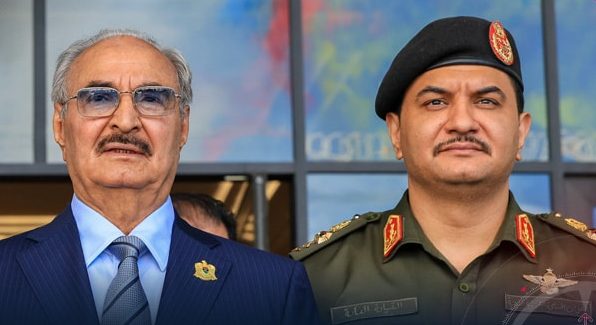
Sirte – Field Marshal Khalifa Belqasim Haftar, the General Commander of the Libyan Armed Forces, announced the launch of a new package of development, service, and strategic projects in Sirte and other Libyan cities during a visit to Sirte. He emphasized that the process of development and reconstruction will not stop until Libya becomes a beacon of security, stability, and prosperity.
Haftar was accompanied by Libyan Prime Minister Osama Hamad, Deputy General Commander Lieutenant General Saddam Haftar, Chief of Staff Lieutenant General Khalid Haftar, and Qassem Haftar, Director General of the Libya Development and Reconstruction Fund. Several members of parliament, tribal elders, and residents of Sirte were also present.
In his address to the people of Sirte, Haftar expressed pride in the city’s urban and environmental progress after years of hardship. He said truly appreciating this renaissance requires comparing Sirte’s current state with its situation a few years ago. Haftar stressed that this progress was not a gift but the result of sacrifice, hard work, and perseverance under difficult conditions. He said determination was stronger than the challenges that faced them.
Haftar noted that work was done quietly, out of a belief in actions over words and achievements over speeches. He urged skeptics to look at the tangible progress in Sirte, describing the results as more impressive than any rhetoric. He said the achievements so far are just the beginning, promising further development not just for Sirte, but for all parts of Libya.
Haftar stated that the ultimate goal is for Libya to become a beacon on the world map for security, stability, construction, and development. He reaffirmed that the Libyan people know the General Command fulfills its promises.
He announced the launch of new development, service, and strategic projects in Sirte and in various Libyan cities to support the national economy, improve services, and promote sustainable development across the country. Haftar stressed that these initiatives do not differentiate between Libya’s regions; he said Libya is a unified nation with one army protecting its people and land, and all Libyans live together as one family.
Haftar described Sirte as Libya’s central pillar and sent a direct message to Libya’s youth, telling them their country needs their minds, efforts, and determination. He called on young people to confidently enter the workforce, contribute to national development, and embrace responsibility, regardless of challenges. Haftar encouraged them to uphold a strong patriotic spirit and play an active role in building a new Libya—one of security, stability, growth, and prosperity. He said what youth plant today, they will reap tomorrow, urging them to sow good for the benefit of their country.
Haftar also praised Deputy General Commander Lieutenant General Saddam Haftar for his efforts in achieving what he called the “great progress” witnessed in Sirte. He commended the Director General of the National Development Authority, all its staff, and everyone involved in project planning and implementation. He congratulated Sirte’s residents and called for the continuation of development efforts.
For his part, Lieutenant General Saddam Haftar wrote on his “X” social media page that Sirte was honored by the visit of Field Marshal Khalifa Belqasim Haftar and accompanying officials. He stated the visit was dedicated to announcing a new package of strategic projects in Sirte and to inspecting ongoing and completed projects.
Saddam Haftar said the new projects include the construction of Khalifa Medical City, Sirte Central Cancer Hospital, and a branch of the Central Bank of Libya. The projects also feature the development of Libya’s largest wastewater treatment plant and the Sirte International Equestrian Track.
He affirmed that these projects reflect the General Command’s commitment to advancing Sirte, keeping pace with major developmental shifts, and ensuring ongoing development across all Libyan regions. He reiterated their dedication to protecting national unity and maintaining Libya’s sovereignty.