

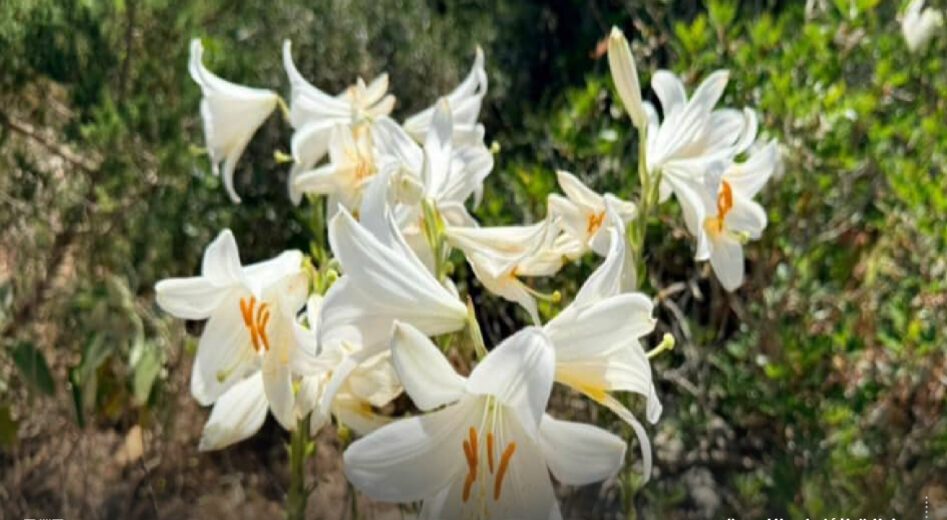
Al-Bayda – Explorer Abdullah Ibrahim Shanabo has announced the discovery of the white lily flower (lilium) at a rare archaeological site in the Green Mountain region. Initial studies suggest that the flower was cultivated during the Greek era, between 1,500 and 2,000 years ago. Researchers believe it was brought across the Mediterranean and planted in the garden of an ancient palace from that period.
Shanabo explained that the white lily held special significance for the Greeks. According to legend, when Hera, wife of Zeus, nursed her son Hercules, drops of her milk fell to the ground and produced the white lily, making it a symbol of purity, love, and peace. The flower’s symbolism continued in the Byzantine era, gaining religious significance and becoming associated with the Virgin Mary as a symbol of virginity, love, and purity.
Shanabo noted that the discovery has historical, environmental, and scientific importance. The plant has survived for centuries, resisting harsh climates and environmental changes, despite being cultivated between 1,500 and 2,000 years ago. He described it as a unique case that deserves thorough research. In Libya, lilies are usually ornamental plants, with more than 140 imported species recorded.
He confirmed that he has assembled a scientific research team to study the plant in detail. The team includes Dr. Jibril Al-Zaqzouq, an ornamental plant specialist at Omar Al-Mukhtar University, and Dr. Khaled Al-Amir. The group has begun detailed research into the plant’s characteristics and ecological history, and will announce their findings once the study is complete.
The search for the flower lasted nine years, culminating in its discovery in 2025. However, the official announcement was made in June 2026 to coincide with International Museum Day, highlighting its cultural and historical significance.
The discovery site is located in the garden of an ancient palace at the summit of a mountain between Ras Al-Hilal and Al-Athrun, near Wadi Marqus. Shanabo mentioned that local residents have long known about the flower’s existence but were unaware of its historical and cultural origins. He indicated that other valuable plants might be found nearby, including silphium, a plant also associated with the same era.