

The Ministry of Education in the Government of National Unity, headed by Abdul Hamid Dbeibeh, has put forward a new proposal that has sparked widespread controversy among citizens. The proposal calls for the abolition of the Preparatory Certificate as a national examination stage, transforming it into a transitional grade evaluated by the student’s annual performance, after which they would proceed directly to the secondary stage without undergoing a unified exam.
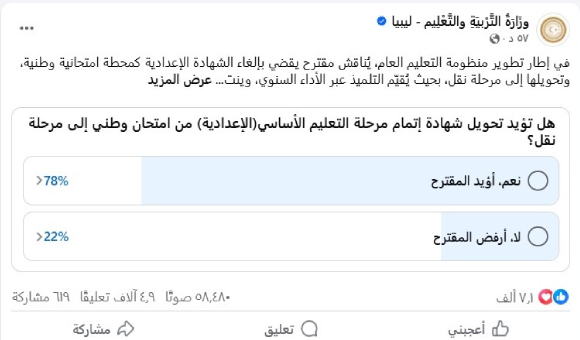
The proposal, introduced through an electronic poll on the ministry’s official page, attracted extensive engagement from followers. As of the preparation of this report, the poll results showed that 78% of participants supported the proposal, while 22% expressed their rejection, reflecting a division in public opinion regarding the feasibility of this shift in the educational system.
Supporters believe the move could contribute to alleviating psychological pressure on students, especially if curricula are developed and qualified teaching staff are selected. This was echoed by one female commenter who supported the proposal, pointing to the necessity of close monitoring of the educational process and a radical amendment of the curricula to align with the stage.
In contrast, opponents expressed multiple concerns about abolishing the certificate. Many consider it a decisive and important stage for evaluating a student’s level before transitioning to secondary education. Mahdi Al-Qaydi stated in his comment that the absence of this exam would lead to the loss of an official standard for measuring academic performance, could affect students’ seriousness in their studies, and weaken the credibility of internal assessments within schools, especially in the absence of strict oversight mechanisms.
Ruwaysa Muhammad, another commenter, stressed the importance of this stage in determining a student’s direction, whether towards secondary or vocational education, describing the proposal as illogical given the varying abilities of students and the challenges of the next stage. Amani Boukhashm opined that the decision marginalizes a segment of students whose educational journey might end before completing the secondary stage, meaning they would be left without an official educational certificate.
From another perspective, Nada Nadousha considered that such decisions should not be left to public opinion or referendums via social media. Instead, they should be made based on scientific studies by specialists in education, so that the educational system is not subjected to further deterioration.
This sharp interaction with the poll reflects the extent of the debate stirred by educational issues in Libya, especially during a transitional phase where the state is seeking genuine development of the sector amidst challenges related to infrastructure, curricula, the efficiency of teaching staff, and disparate conditions across different regions.
The proposal remains in the discussion and polling phase, amidst anticipation of what the Ministry of Education, headed by Ali Al-Abed, will announce regarding the next steps based on the results of the engagement and ongoing consultations with stakeholders in the sector.