

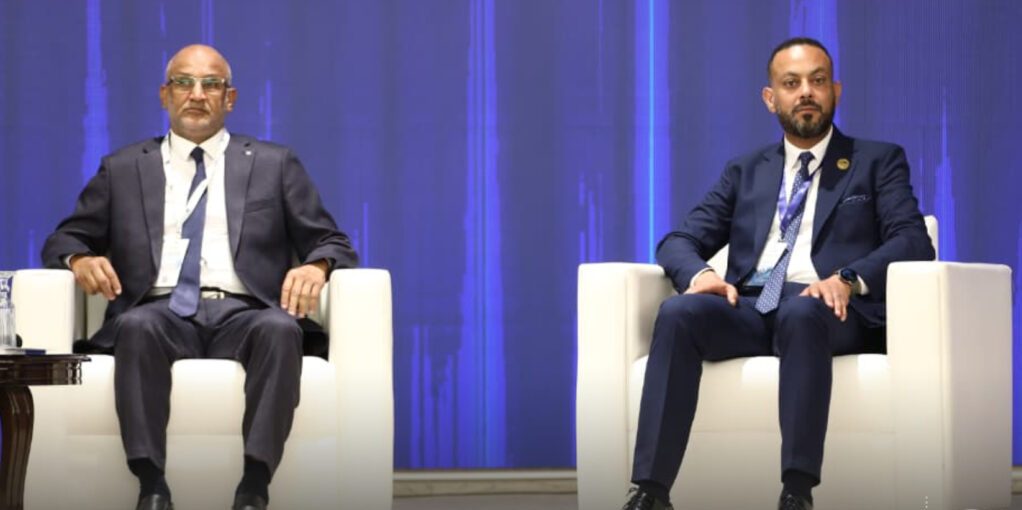
Benghazi – An academic study presented at the first International Conference on Justice and Reform, held in Benghazi from July 28 to 30, found that the National Committee for the Follow-up of Prisons and Prisoners made significant institutional and operational progress during its initial phase from January to June 2026. However, the study noted a need to improve communications through more balanced media coverage and a wider range of sources.
The study, prepared by Professor Dr. Mohamed Salem Al-Menfi and Dr. Ibrahim Hadiyah Al-Mjebri, used the Four-Dimensional Evaluation Framework (FDEF), which measures institutional capacity, operational output, communications performance, and sustainability. The researchers analyzed official documents, statistics, and 127 media pieces, and conducted an in-depth interview with the committee’s chairman, Counselor Ibrahim Bushnaf. They also used data triangulation to verify results.
According to the study, the committee quickly established a strong institutional base through its formal creation, definition of responsibilities, and the holding of eight coordination meetings with judicial, security, government, and international bodies. The committee also expanded its operations from Benghazi to include Al-Bayda, Derna, and Jabal Al-Akhdar, and opened direct communication channels with the public, reflecting advances in institutional capacity-building.
The study found that the committee achieved notable concrete results, including the release of hundreds of inmates in several stages. Releases included 250 inmates from the Qirnada Reform and Rehabilitation Center and 173 from various institutions in eastern Libya, along with a group from the Military Police Prison. The committee also carried out field visits to five correctional facilities and reviewed legal files with the public prosecutor and courts to expedite release orders and judicial decisions.
Regarding communications, the study noted that media coverage reached high levels of accuracy and verification, and good neutrality, but scored only average on depth and continuity. The use of evidence and balance in sourcing was weaker, with the overall Media Content Quality Index (MCQI) average at 2.61 out of 5.
The report also showed that 44.9 percent of media coverage focused on the committee’s institutional aspects, 26 percent on achievements, and 24.4 percent on national context. Only 4.7 percent addressed human rights and humanitarian dimensions, highlighting a need to strengthen these aspects in media discourse on justice and reform initiatives.
On sustainability, the study identified positive steps such as building a network of institutional relationships and proposing the creation of a permanent body to oversee prison affairs. The committee is also working to improve follow-up mechanisms and impact measurement, but faces challenges including uneven conditions in reform institutions, the need to update databases, and the need for better coordination among stakeholders.
The study concluded that the success of the committee’s initial phase was based on phased planning, institutional coordination, and organized communication. It stressed that developing a more comprehensive communication strategy with diverse sources and balanced coverage would further increase institutional trust and boost the effectiveness of national reform efforts.
Recommendations included testing the FDEF framework in other national initiatives, developing the MCQI indicator, adopting key performance indicators to measure results, expanding institutional communications, accelerating releases according to clear timelines, and enhancing reintegration programs. The study also suggested considering the transformation of the committee into a permanent, financially and administratively independent body to ensure sustainability.
The researchers stated that the study’s findings support adopting the FDEF as a scientific tool to assess national justice and reform initiatives, paving the way for its use in other national contexts to establish scientific methodologies for institutional performance assessment, strengthen academic knowledge, and support policy development in the field.