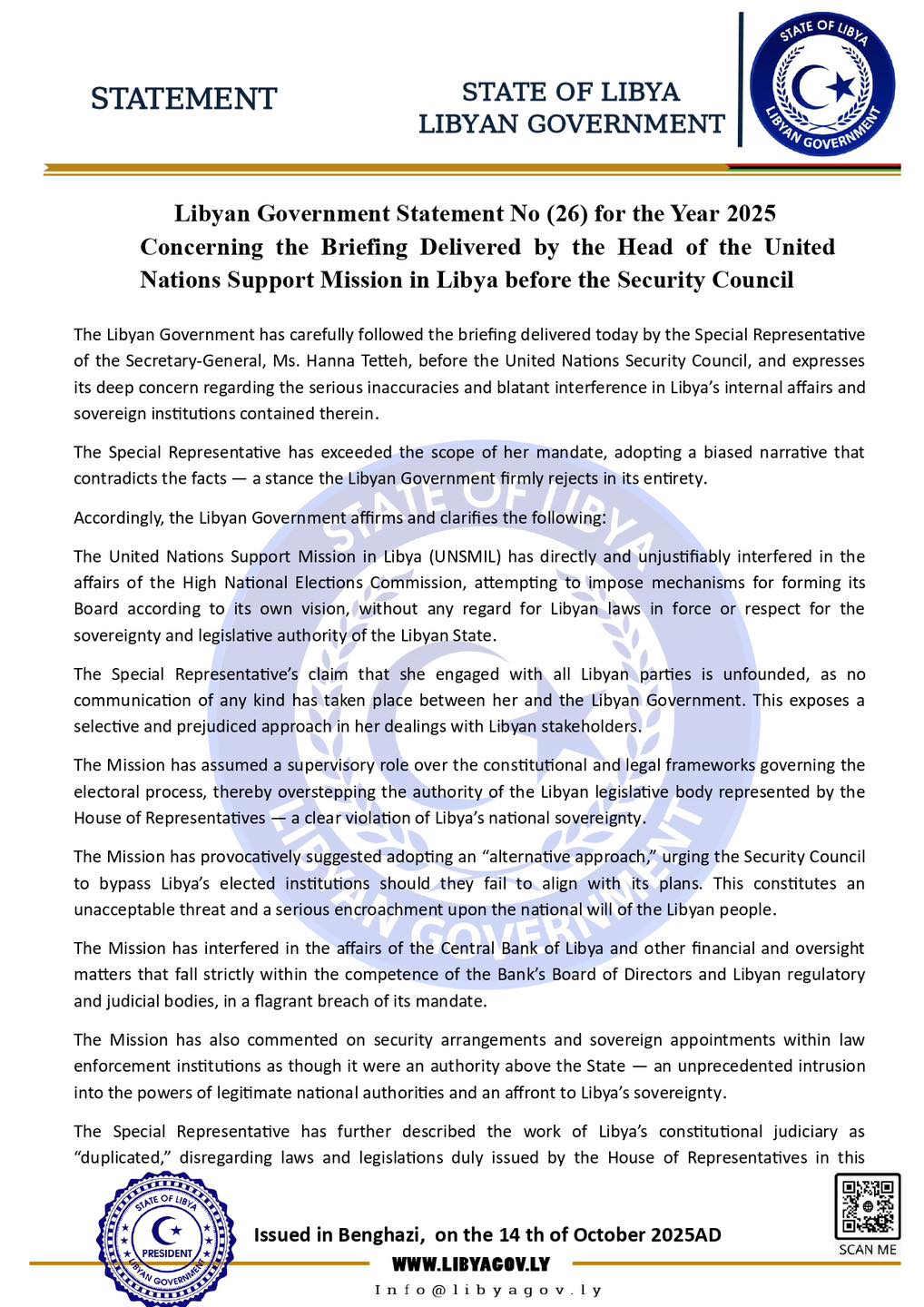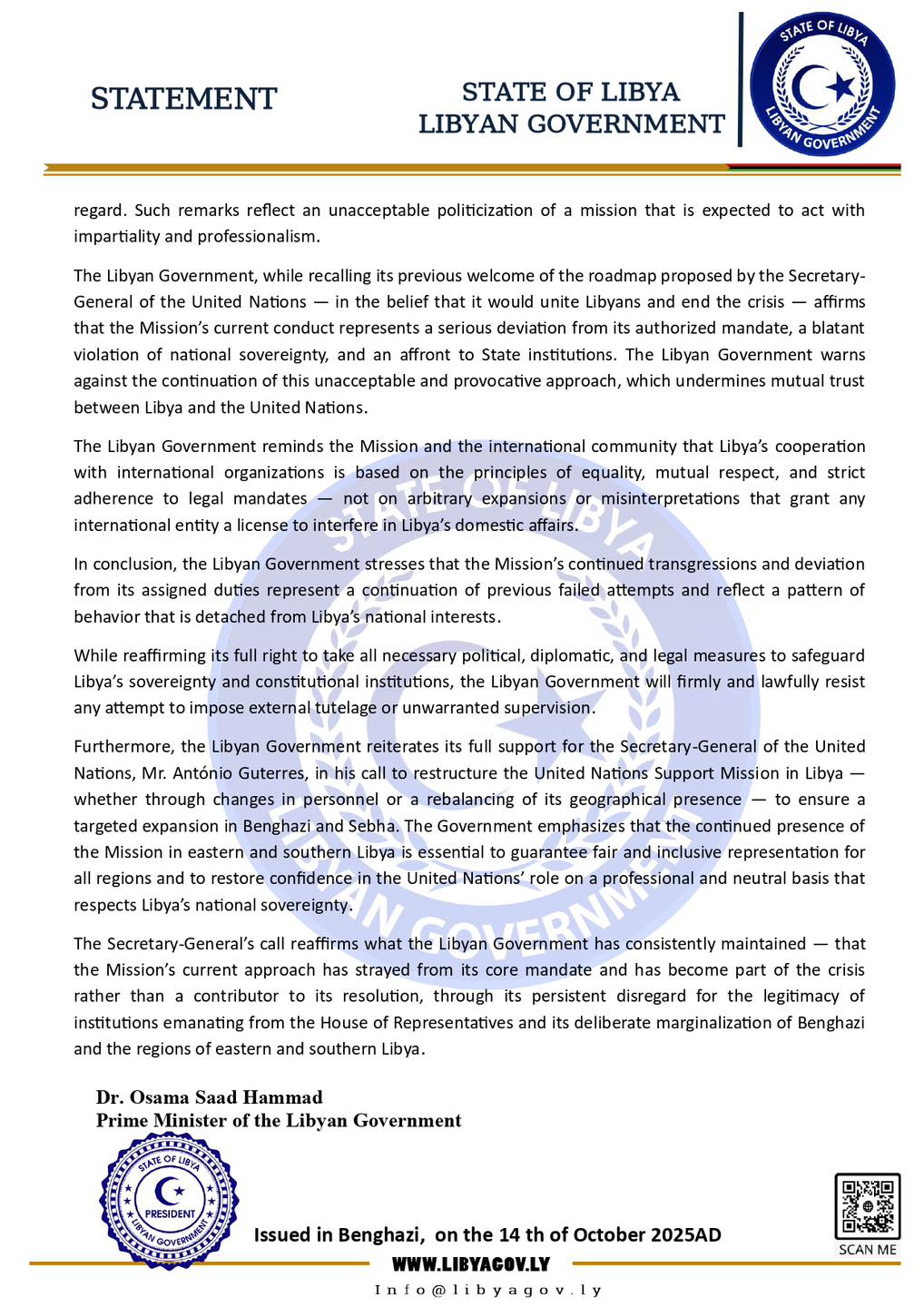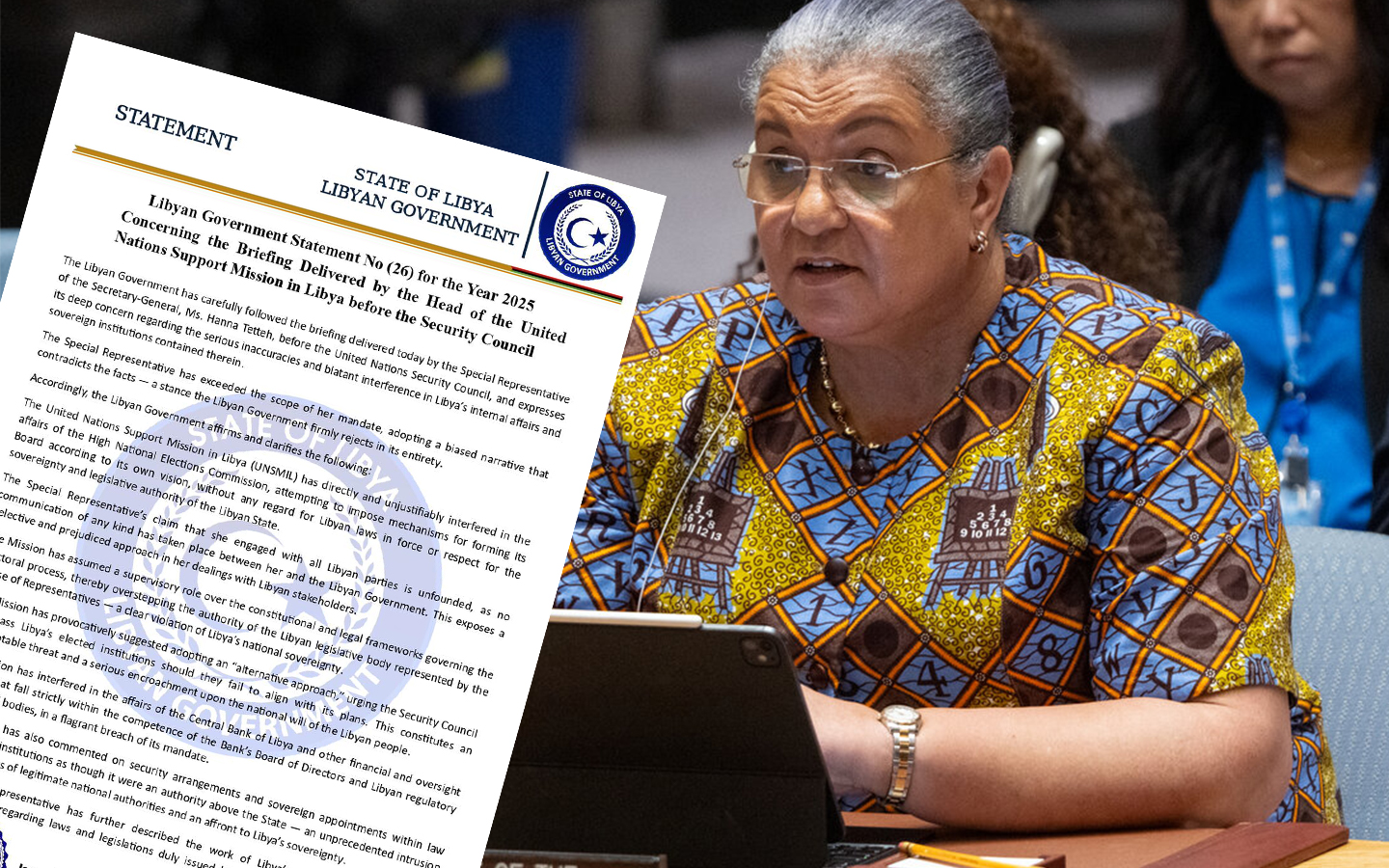
The Libyan government affirmed its rejection of the briefing presented by the Special Representative of the Secretary-General, Hanna Tetteh, before the Security Council, considering it full of serious fallacies and blatant interference in the internal affairs of the state and its sovereign institutions, exceeding the limits of the official mission’s mandate and adopting a biased narrative contrary to the facts.
The government clarified in a statement that the UN mission interfered directly and unjustifiably in the affairs of the High National Elections Commission, attempting to impose mechanisms for forming its council according to its own vision, without respect for Libyan laws or the sovereignty of state institutions.
It pointed out that the Special Representative’s claim of holding meetings with all Libyan parties is entirely false, as no communication was made with the Libyan government, which reveals a selective and biased approach in her dealings with national parties.
The government noted that the mission has appointed itself as a guardian over the constitutional and legal legislation governing the electoral process, overstepping the jurisdiction of the Libyan legislative authority, represented by the House of Representatives. It also adopted an alternative approach calling on the Security Council to bypass the elected Libyan institutions, which the government described as an unacceptable threat and an infringement on the national will.
The government continued that the mission interfered in the affairs of the Central Bank and financial and regulatory matters, as well as discussing security arrangements and sovereign appointments within law enforcement institutions, which is an unprecedented encroachment on the competencies of the legitimate national authorities.
It also criticized the Special Representative’s description of the judicial authority’s work as dual, ignoring the laws issued by the House of Representatives, which reflects an unacceptable politicization of the mission.
The government indicated that these practices represent a serious deviation from the mandate granted to the mission, a violation of national sovereignty, and an insult to state institutions, warning against the continuation of this rejected and provocative approach which undermines trust between Libya and the United Nations.
The government affirmed that Libya’s respect for international organizations is based on parity, mutual respect, and adherence to national laws, not on an erroneous interpretation that grants any international body a license to interfere in national affairs.
In conclusion, the government stressed its full right to take political, diplomatic, and legal measures to protect Libya’s sovereignty and its constitutional institutions, and its full support for the UN Secretary-General António Guterres in his call to restructure the United Nations Support Mission in Libya, in a way that ensures fair and comprehensive representation for all regions of Libya and restores confidence in the UN’s role on professional and neutral grounds, especially in the East and South.