

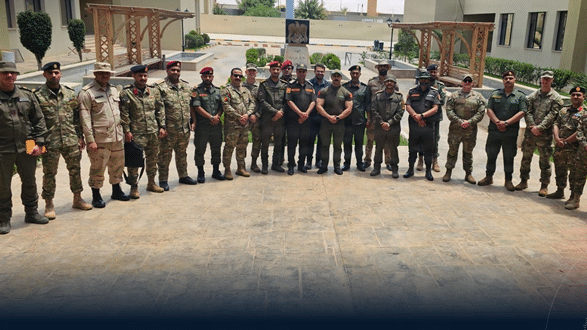
Libya – A recent field report has confirmed that soldiers from the US Army’s Bravo Company, part of the Civil Affairs Battalion under US Army Southern European Task Force, Africa, are sharing military expertise with Libyan officers from the armed forces and military groups affiliated with the Presidential Council’s General Staff.
The report, published by the US Department of Defense news section and translated by Al-Marsad, said these monthly exchanges will continue until the end of the fiscal year. This ongoing program aims to open a new chapter in Libya’s evolving history.
Bravo Company Commander Maj. Miles Dunning stated that Libya has seen significant security improvements since 2011. He noted that several governments recognize the armed forces as the legitimate authority, while others recognize the Dbeibah government. He emphasized the main goal is a unified Libya with joint military capabilities to combat terrorism.
Dunning added that the US seeks to bring both parties to the negotiating table to unite Libya under one government. The military exchanges are designed to create an environment for direct dialogue and cooperation between the two partner forces, facilitating knowledge sharing.
According to Dunning, both sides were represented by 21 officers, ranging in rank from captain to colonel. He confirmed that the partner forces have shown interest in building a stronger, more stable Libya. The relationship between both sides was described as very positive, with a willingness to pursue lasting peace and continue future exchanges.
Dunning said this exchange is the first of its kind and marks a pivotal moment in building relations between the US military and Libyan forces. He pointed out that the American force is now the only regular military presence in Libya following this engagement.
The report also noted that the Civil Affairs team discussed how the US Army conducts joint weapons operations. They reviewed American combat functions, military decision-making processes, command procedures, and operational orders. The exchange concluded with a tabletop simulation exercise set in a fictional country.
During the exercise, participants were tasked with clearing a road between two villages. After receiving specific resources for the simulated mission, representatives from both partner forces explained their methods for accomplishing the task.
Dunning stated that the insights gained from these exchanges will help develop successful partnerships between the United States and Libyan forces. He said the program creates opportunities for open dialogue, strengthens communication, and improves joint operations. The Libyan partners, in turn, gain a better understanding of how the US military operates.
Dunning concluded by describing the event as historic, after years of planning with various agencies, especially the Office of Security Cooperation. He noted that hundreds of hours of work went into making this possible. For the first time in 16 years, a US Army unit is present in Libya, marking a significant first step in rebuilding military relations with the country.