

Political analyst Arabi Al-Werfalli said that instead of Libya moving towards elections and stability, the conversation today is about disputes within the capital, Tripoli, and armed confrontations between armed militias that control the reality on the ground.
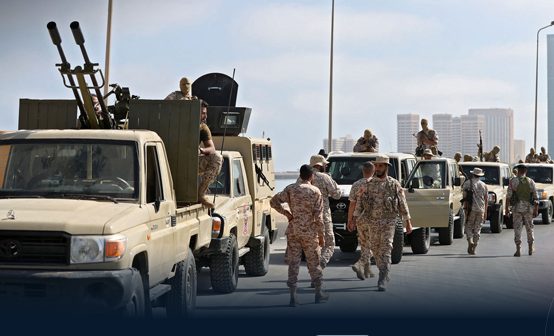
Al-Werfalli explained during special coverage on the “Libya Al-Hadath” channel, followed by Al-Marsad newspaper, that Tripoli has been on edge for the past two months due to mobilizations from Misrata. Convoys heavily armed with weapons and tanks entered under slogans he described as “flimsy,” such as “ending the Deterrence Force” and “state stability.”
He added that the recent agreement saved the capital temporarily but will not last long, pointing out that the conflict for influence and money among the militias continues. He noted that the current calm came under Turkish orders, which prevented the outbreak of war inside the densely populated Tripoli. He pointed out that the agreement was not signed by the Libyan parties and that Turkey is its sole guarantor, after it stipulated the withdrawal of the Deterrence Force from Mitiga Airport and other militias from Misrata and Zuwara airports.
Al-Werfalli accused the isolated Mufti, Sadiq al-Ghariani, of inciting the release of extremist prisoners from the Deterrence Apparatus. He also accused the head of the Government of National Unity, Abdul Hamid Dbeibeh, of seeking to control the capital after overthrowing the Stability Support Apparatus led by Ghinwa, and then turning his attention to the Deterrence Apparatus, which almost ignited a war with the participation of Misrata militias.
He opined that direct Turkish intervention prevented the war, stressing that Dbeibeh’s recent visit to Ankara witnessed decisive pressure from the Turks to stop the confrontations. He considered that Turkey manages the Libyan file according to its security and economic interests and may change its positions towards the militias whenever its interests dictate.
Al-Werfalli pointed out that the radical solution lies in disarming the militias that control the state’s resources, not merely redeploying them between airports. He said that the experience in cities like Sirte and Benghazi has proven that military decisiveness led to security and development, while the west remained under the control of armed groups.
He explained that the absence of security obstructs any political process and that holding elections is possible in the east but not in Tripoli. He added that the militias in the west include ideologized factions such as the Brotherhood and the Shields, alongside groups seeking money and influence.
He emphasized that citizens have suffered from various militias and that the military institution was established in response to popular calls to protect the people, noting that cities like Derna are witnessing development projects thanks to security stability. He accused al-Ghariani of continuing to incite against the military institution and calling for the formation of new militias.
Al-Werfalli concluded that political blackmail in the capital will continue, with the ongoing siege of institutions and the imposition of levies. He recalled the statements of the Governor of the Central Bank of Libya about seeking to eliminate these practices, stressing that Tripoli’s crisis does not lie with its residents but with the militias coming from outside it, whose tanks still roam its streets.