

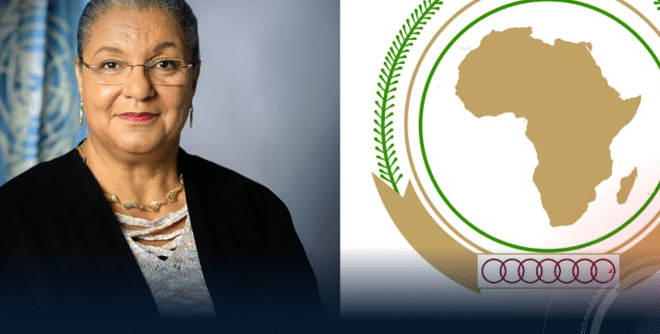
Libya – An analytical report published by Algeria’s “Al-Ayam News” has highlighted the challenges of political transition and prospects for a settlement in Libya. The report examined ongoing coordination between the United Nations and the African Union on the Libyan file.
According to the report, the Libyan file has returned to the forefront of UN-African Union discussions amid a complex political and security landscape. Internal divisions and competing centers of power in Libya continue to complicate any efforts to advance the political transition. This makes every international briefing or regional meeting more than a routine diplomatic event.
The report described a recent briefing by UN envoy Hanna Tetteh to the African Union Peace and Security Council as a platform to reshape discussions on Libya’s transitional phase. There remains a pressing need for stronger and more cohesive international and regional coordination that can keep pace with Libya’s shifting realities.
Mohamed Imteirite, a researcher in strategic studies quoted by the report, said this development reflects renewed efforts by the United Nations to reposition itself in a Libyan environment marked by growing political and security complexities, multiple centers of power, and constant interaction between local, regional, and international actors.
Imteirite argued that the latest UN briefing should be seen not just as a diplomatic event, but as part of a broader process to reshape UN intervention tools in Libya. He noted that traditional approaches based on large conferences and comprehensive initiatives have shown limited success in breaking the deadlock of Libya’s protracted crisis.
He added that the shift in the UN’s approach demonstrates growing recognition within the organization that managing the Libyan crisis can no longer rely on quick fixes or ready-made settlements. Instead, it requires a more flexible, gradual strategy built around partial understandings among key parties.
Imteirite said the new direction aims to break up complex political, security, and economic issues into separate tracks for gradual resolution, rather than attempting a comprehensive settlement all at once. However, he cautioned that this approach faces clear limitations.
He pointed out that the UN mission struggles to impose its own political direction, especially as regional and international actors increasingly influence Libya’s internal balance of power, sometimes outside the UN framework altogether.
Regarding coordination mechanisms, Imteirite saw the partnership between the United Nations and the African Union as a key step towards strengthening international and regional cooperation on the Libyan issue. Yet, in practice, it is more a functional division of roles than truly integrated institutional cooperation.
He explained that the United Nations still holds the central role in shaping political initiatives and setting negotiation frameworks. Meanwhile, the African Union acts mainly as a regional supporter, providing broader legitimacy for any continental agreement.
Imteirite emphasized that this division of roles, while important, remains of limited effectiveness unless both institutions can directly influence Libya’s complex internal power structure, where political, military, and economic interests intersect.
He said the real challenge is moving from diplomatic coordination to direct impact on Libya’s internal dynamics, which has not yet been accomplished. According to Imteirite, the effectiveness of international or regional efforts depends not only on institutional coordination but also on the ability to translate that coordination into real leverage on the ground.
Imteirite noted that current political tracks, such as structured dialogue, signal a fundamental shift in the UN’s approach to the Libyan crisis. The focus has moved from comprehensive settlements to a more incremental strategy, reflecting both changes in tools and a realistic assessment of the difficulties in imposing a final agreement in the immediate future.
He warned that this approach could prolong the transitional phase in Libya rather than end it. Without a clear political framework defining the transition, there is a risk of indefinite extensions through a series of temporary arrangements that address some symptoms but not the structural roots of Libya’s crisis.
Imteirite stressed that the success of the current approach depends on its ability to move from broad political recommendations to concrete, enforceable commitments that can be measured and implemented. He pointed out that previous UN initiatives have often faltered not for lack of vision, but due to weak enforcement mechanisms, leaving their recommendations open to interpretation without clear obligations.
He concluded that real progress in Libya will depend on the international community’s ability to convert current agreements into practical, measurable steps, rather than issuing political statements or open-ended dialogues. Libya remains mired in a prolonged transitional period, and international initiatives continue to intersect with internal divisions. So far, no decisive path has emerged to break the political deadlock. The key challenge, he said, is not simply drafting initiatives, but ensuring they are executed and transformed into a stable political reality that rebuilds state institutions on inclusive foundations.